
The Audit-First Economy: Navigating Regulatory Realignment in the U.S. and Canada
United States: The expanded Section 232 "Full Value" rule for copper creates an immediate "Metal Tax" on all industrial machinery value.
Canada: Intensified "Buy Canadian" enforcement requires mid-market firms to provide documented value-chain audits to secure federal contracts.
Strategic Solution: Forensic Governance identifies the 4% OpEx leakage needed to fund these new compliance and traceability requirements.
As of May 8, 2026, the North American manufacturing sector has moved past the phase of "trade anxiety" into a period of clinical, high-stakes operational realignment. While the headlines focus on geopolitical shifts, the reality for mid-market firms is found in the audit trail. In both the U.S. and Canada, the price of doing business now includes a rigorous "Proof of Origin" and "Value Traceability" mandate.
I. United States: The Copper Tax and the Traceability Test
The U.S. manufacturing landscape has been fundamentally altered this week by two surgical regulatory moves that prioritize domestic security over trade fluidity:
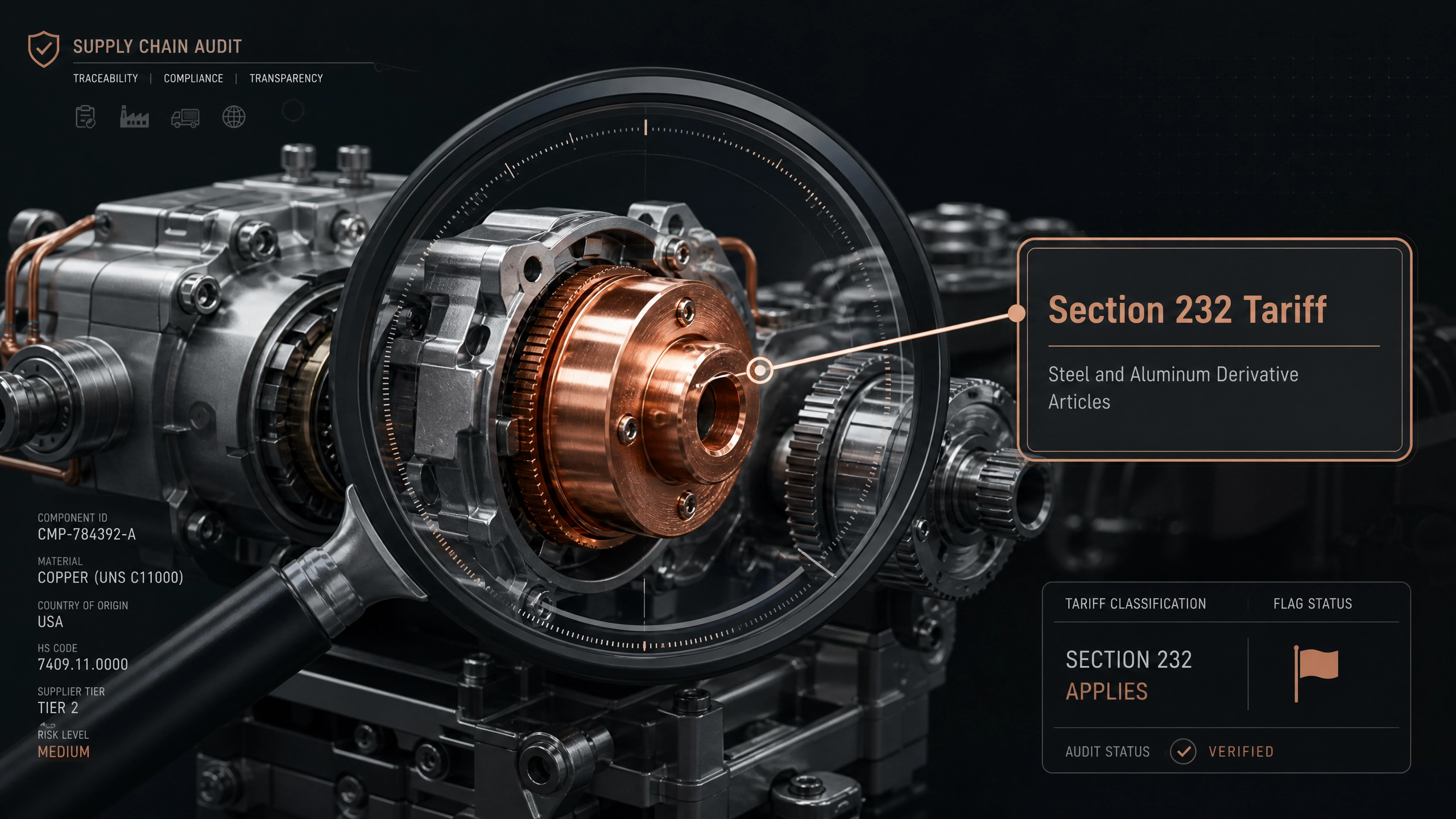
Section 232 Expansion: The May 1 proclamation officially includes copper-containing products under Section 232 tariffs. Critically, the "Full Value" rule now applies the tariff to the entire product value, not just the raw metal content. For manufacturers of electronics or specialized machinery, this is no longer a "raw material cost"—it is a direct levy on your final product’s value.
IRS Notice 2026-15: The Treasury has released the first "Prohibited Foreign Entity" (PFE) filter for OBBBA credits (45X/48E). To secure these credits, U.S. manufacturers must now provide audit-proof documentation tracing supply chains two steps up (Tier-2 components).
The Expert View: These shifts represent a move toward "Precision Protectionism." Manufacturers can no longer rely on broad "Made in USA" claims. If your Tier-2 components cannot survive a PFE audit, your tax credits are dead on arrival. We recommend an immediate forensic audit of all mixed-material component origins to mitigate Q2 duty exposure.
II. Canada: Federal Enforcement and the SR&ED Pivot
North of the border, the focus has pivoted to domestic protectionism and fiscal liquidity as growth slows to a forecasted 1.2%:
"Buy Canadian" Enforcement: Following the December 2025 launch, federal agencies are now requiring mandatory value-chain audits for major construction and defense procurements. Canadian firms with "leaky" supply chains involving undocumented foreign inputs risk losing their "Canadian Supplier" status, effectively barring them from the most stable contracts in the current economy.
Bill C-15 & the SR&ED Enhanced Credit: Effective March 2026, Eligible Canadian Public Corporations (ECPCs) can finally access the 35% refundable rate on the first $6M of R&D. However, this comes with a "Revenue Trap": the credit phases out rapidly as gross revenue exceeds $15M.
The Expert View: For Canadian manufacturers, the "Paperwork Gap" is the new barrier to entry. Passing a federal domestic-content audit is no longer optional for growth. Simultaneously, micro-caps must surgically manage their revenue recognition to avoid growth-triggered tax cliffs. We recommend a procurement-level audit to solidify your "Canadian origin" status before the next contract cycle.

Conclusion: Reclaiming Sovereignty through Forensic Governance
While the specific catalysts differ by geography, the burden on the manufacturer is identical: a sudden, mandatory increase in administrative and operational costs. These aren't just "taxes"; they are structural shifts in how profit is governed.
"Whether you are navigating the U.S. 'Metal Tax' or the Canadian 'Origin Audit,' compliance is no longer a paperwork exercise—it is a margin protector. At Profit Logic, we don't just point out these new costs; we find the 4% OpEx leakage currently hidden in your P&L to fund the solutions. This reclaimed capital—the Modernization Dividend—is what allows you to build an audit-proof supply chain without taking on new debt." — Greg Rusnell, Managing Director at Profit Logic
In this "Audit-First" economy, the winners aren't just those with the best products; they are the manufacturers who apply Forensic Governance to turn hidden waste into a strategic compliance fund.
