
The 2026 Manufacturing Investment Compass: Navigating the Silent Reallocation of Capital
Since January 1, 2026, the North American industrial corridor has undergone a massive, albeit silent, reallocation of capital. While headline-grabbing investments totaling $273B—largely concentrated in the "Battery Belt" [US] and domestic semiconductor acts—dominate the news cycle, a deeper, more forensic trend is emerging among the "backbone" manufacturers. The current market has reached a point of maturity where the "excitement" of digital transformation has been replaced by the discipline of Capital Sovereignty. Mid-market leaders are no longer investing in "hope"; they are investing in the physical and digital moats that protect their margins from grid volatility, labor scarcity, and trade friction.
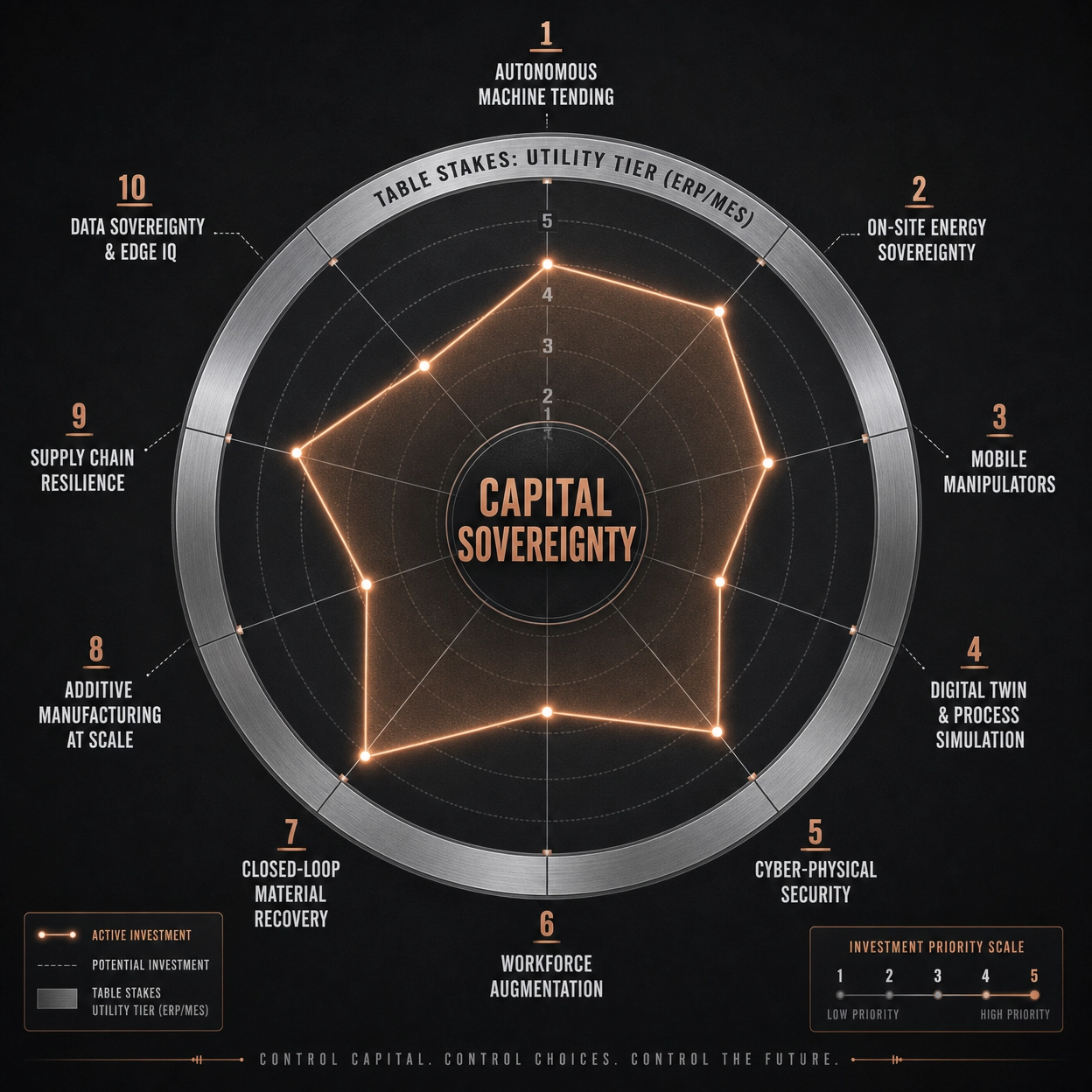
The Q1/Q2 2026 investment landscape is defined by ten high-impact areas where capital is moving with velocity. We see a definitive shift toward Autonomous Machine Tending and Mobile Manipulators, moving robotics from static cells to flexible, floor-wide assets. Simultaneously, On-Site Energy Sovereignty has moved from a "green initiative" to a core financial strategy; manufacturers are treating microgrids and thermal storage as capital assets to hedge against peak-shaving costs and grid instability [North American]. This shift toward "Sovereignty" extends to the molecular level, with Advanced Closed-Loop Material Recovery becoming a critical hedge against specialized alloy price spikes.
The most telling indicator of this new era is the migration of capital away from the "Utility Tier." Foundational digital tools such as IoT, ERP, and MES have slipped out of the Top 10 investment priorities. The industry has reached a collective conclusion: an ERP upgrade does not solve a productivity crisis—it only records it more accurately. The 2026 mandate prioritizes Direct Action Tools—such as Industrial Edge Intelligence and Flexible Additive Tooling—that solve physical bottlenecks at the source, bypassing the latency of centralized reporting systems and traditional supply chain lead times.
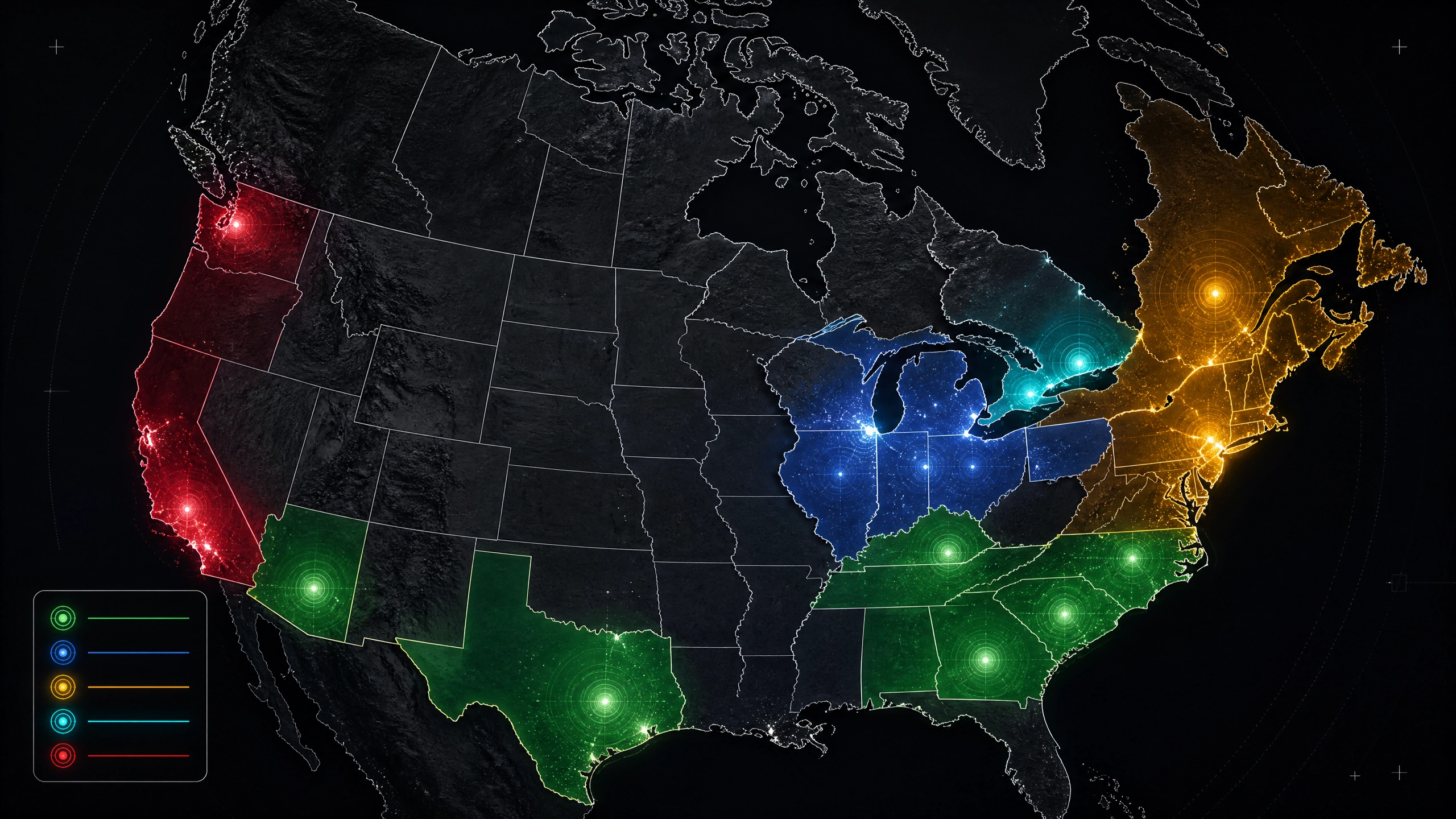
The regional execution of these strategies reflects a specialized "North American Map." In the Midwest Integration Zone [US], capital is flowing into "retrofitting intelligence" into 20th-century brownfield plants. Conversely, the Southern Ontario High-Tech Corridor [Canada] is leveraging R&D incentives to lead in "Circular Material Recovery" and AI-driven predictive governance. In the American West [US Example], the focus has shifted to extreme-precision robotics and "Hardware Sovereignty" to protect against the rising tide of industrial ransomware targeting operational technology (OT).
The conclusion for the modern CEO is clinical: The barrier to modernization is rarely technological; it is a Capital Bottleneck. While Tier-1 firms leverage massive cash reserves, mid-market manufacturers often pause these critical pivots because they believe their capital is tapped out. However, our research confirms that in most facilities, 3% to 4% of total revenue is currently leaking through un-governed OpEx and vendor decay. This is the Modernization Dividend—the "found capital" already living inside your P&L.
True Structural Profit Optimization (SPO) is the governance layer that bridges this gap. By reclaiming the structural leakage inherent in legacy vendor contracts and administrative bloat, a manufacturer can self-fund their transition to Energy Sovereignty or Robotic Tending without taking on new debt or diluting equity. The leaders of the 2026 resurgence won't be the ones who borrowed the most to buy tech—they will be the ones who governed their operations well enough to own their future.
[1.1] Q1 2026 Capital Flow Report: Analysis of $273B in North American "Battery Belt" and Semiconductor investments.
[2.1] Industrial Energy Resilience Study: Trends in on-site microgrid adoption and peak-shaving arbitrage (April 2026).
[3.1] The Edge Intelligence Surge: Deloitte/PwC 2026 Outlook on decentralized execution over centralized ERP.
[4.1] Regional Manufacturing Heat Map: Analysis of investment pulses across the Southeast US, Midwest US, and Canadian Industrial Corridors.
[5.1] The "Modernization Dividend" Diagnostic: Profit Logic Internal Data on OpEx leakage vs. CapEx requirements for mid-market SMEs.
Custom HTML/CSS/JAVASCRIPT
