The Capital Allocation Pivot: Self-Funding the Floor Plate Modernization
Every mid-market manufacturing CEO has a spreadsheet buried in their desktop files labeled 2026/2027 Capital Expenditures. Under the "Production Expansion" tab, the line items read like a wish list for operational autonomy: collaborative assembly arms, autonomous mobile robots (AMRs) for material handling, and vision-guided automated inspection cells.
The engineering team knows exactly which hardware will eliminate your floor plate bottlenecks. The operations team can show you the exact workstations where labor constraints are throttling your daily throughput.
Yet, those lines remain unapproved.
In the high-interest-rate environment of 2026, looking at a seven-figure automation purchase order feels like a direct threat to your balance sheet. Commercial equipment financing costs are sitting at persistent highs, and borrowing millions to fund a physical robotics rollout risks choking your cash flow and driving down your Debt-Service Coverage Ratio (DSCR).
This is the central paradox facing the modern industrial corridor: You must automate to scale, but borrowing to automate can paralyze your liquidity.
To break this gridlock, forward-thinking executives are moving away from traditional financing and deploying an offensive cost reclamation strategy. By treating legacy operational waste as a direct funding source, you can systematically transition your facility into Next-Gen Smart Production without writing a single check to an outside lender.
I. The Reality of the Floor Plate: Hardware & Hard ROI
Physical automation is no longer a luxury reserved for multi-billion-dollar automotive OEMs. In the mid-market, it has become the fundamental line of defense against a permanently tight labor pool and escalating operational friction.
When you shift from manual execution to autonomous smart production, the financial returns shift from incremental to exponential. Consider three dominant pillars of physical automation currently reshaping the factory floor:
+-------------------------------------------------------------------+
| THE NEXT-GEN SMART PRODUCTION PILLARS |
+-------------------------------------------------------------------+
| 1. COLLABORATIVE ROBOTICS (COBOTS) |
| • Focus: Machine tending, precision welding, assembly, gluing. |
| • Outcome: High repeatability, decoupled from operator turnover. |
+-------------------------------------------------------------------+ | v
+-------------------------------------------------------------------+
| 2. AUTONOMOUS MATERIAL HANDLING (AGVs / AMRs) |
| • Focus: Forklift elimination, intra-facility transport, kitting. |
| • Outcome: Zero indirect labor waste, automated flow velocity. |
+-------------------------------------------------------------------+ | v
+-------------------------------------------------------------------+
| 3. PHYSICAL AI & MACHINE VISION |
| • Focus: Sub-millimeter high-speed automated quality inspection. |
| • Outcome: Scrap reduction, elimination of warranty chargebacks. |
+-------------------------------------------------------------------+
1. Collaborative Industrial Robotics & Cobots
Unlike legacy industrial robots that require massive safety cages and dedicated programming teams, modern collaborative robots (cobots) work alongside human operators, feature drag-and-drop programming, and plug directly into standard plant-floor electrical drops.
Key Solutions: Systems like the FANUC CRX Industrial Cobot Series or the Universal Robots e-Series Platforms.
The Benefit: Decoupling machine-tending (CNC, brake press, injection molding) and high-volume repetitive tasks (glue dispensing, palletizing) from manual labor.
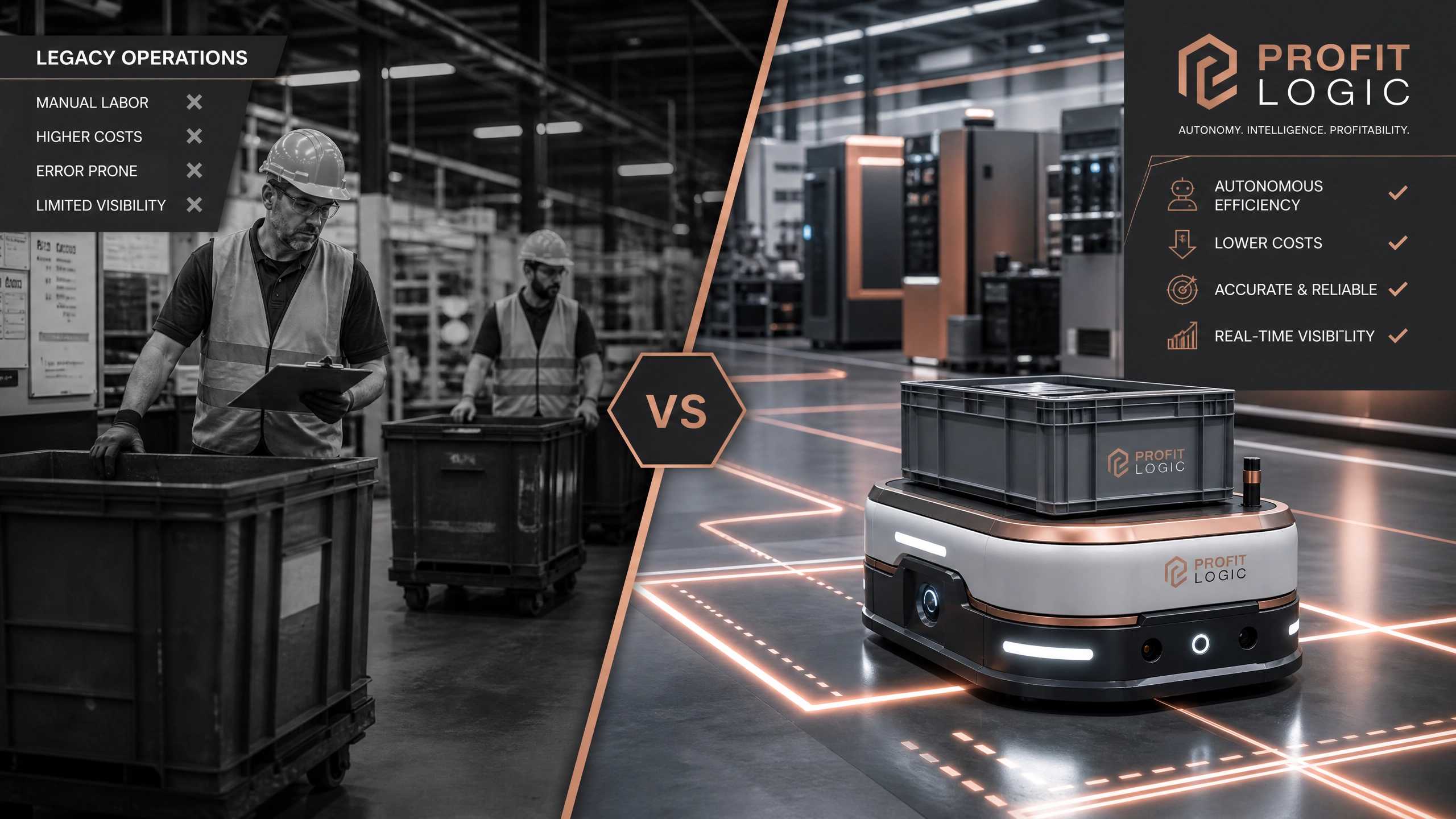
Eliminating indirect labor waste: Vision-guided autonomous mobile robots (AMRs) synchronizing material drops with real-time machine cycle times.
2. Autonomous Material Handling (AGVs/AMRs)
Moving materials manually from a receiving dock to a production line or finished goods warehouse is a pure, indirect labor cost that adds zero value to the finished product.
Key Solutions: Systems like KUKA Autonomous Mobile Robots, Mobile Industrial Robots (MiR), or advanced logistics platforms from Boston Dynamics.
The Benefit: Replacing human-operated forklifts with vision-guided autonomous vehicles that optimize layout paths in real time, synchronizing material drops precisely with machine cycle times.
3. Physical AI & Machine Vision
Human quality inspection is inherently variable, subject to fatigue, and slow. Advanced machine vision arrays powered by edge-computing neural networks inspect 100% of production components at full line speed.
Key Solutions: Systems engineered by industry pioneers like Cognex Industrial Vision or Keyence Sensors & Vision Arrays.
The Benefit: Immediate identification of sub-millimeter defects, giving you the ability to halt an out-of-tolerance process before thousands of parts are ruined, fundamentally eliminating scrap and customer warranty chargebacks.
II. The Proof in the P&L: Public Use Cases
The return on investment for these technologies is well-documented and verified by public industrial data. These aren't beta tests; they are structural margin expansions:
The Machine Tending Leverage: In an automated CNC machine-tending implementation utilizing FANUC LR Mate robotics paired with automated integrators, an Ohio precision component facility reported saving 1.5 minutes per part. While the robotic movement added a slight 20-second cushion to the raw machining time, it slashed total daily cycle times by 1.5 hours per shift by completely removing human loading delays. The result was a 33% increase in total production efficiency and a full project payback in 33 weeks.
The Processing and Scrap Dividend: In a high-volume assembly application involving intricate glue dispensing, aerospace components manufacturer Tool Gauge integrated Universal Robots cobots to take over manual parts manipulation. The automated pathing was so precise it reduced the required operator count by 75% while simultaneously doubling overall line production. Crucially, the extreme consistency of the automated fluid line drove the facility’s scrap rate down from 15% to less than 3%, yielding a complete ROI in less than 12 months.
III. The Marketplace Reality: The Real Cost to Implement
Despite the strength of these use cases, mid-market CFOs often balk at the true cost of implementation. The hardware is only one piece of the financial equation.
To install a single cobot machine-tending cell or a small fleet of AMRs, the true market pricing breaks down into a 1:2 ratio:
The Base Asset: A high-quality cobot arm or autonomous vehicle costs between $35,000 and $75,000.
The Integration Premium: Engineering fees, custom end-of-arm tooling (grippers, welders, cameras), safety sensors, logic PLC programming, and physical plant modifications routinely push the final, fully-commissioned cost of that single cell to $120,000 to $250,000.
If your strategic plan requires a multi-line upgrade of four automated cells and an AMR material loop, you are looking at a capital allocation requirement of $800,000 to $1,000,000.
When that figure hits the executive desk, the conversation usually shifts to commercial equipment financing. But at current commercial rates, a $1 million equipment loan translates into an aggressive monthly debt service that squeezes your operating cash flow and limits your agility if macro-conditions shift mid-year.
IV. The Profit Logic Bridge: Funding Automation via Reclaimed OpEx
There is an alternative financing strategy that protects your balance sheet, preserves your credit line, and keeps your equity entirely intact. You can act as your own lender by tapping into an asset you are currently wasting.
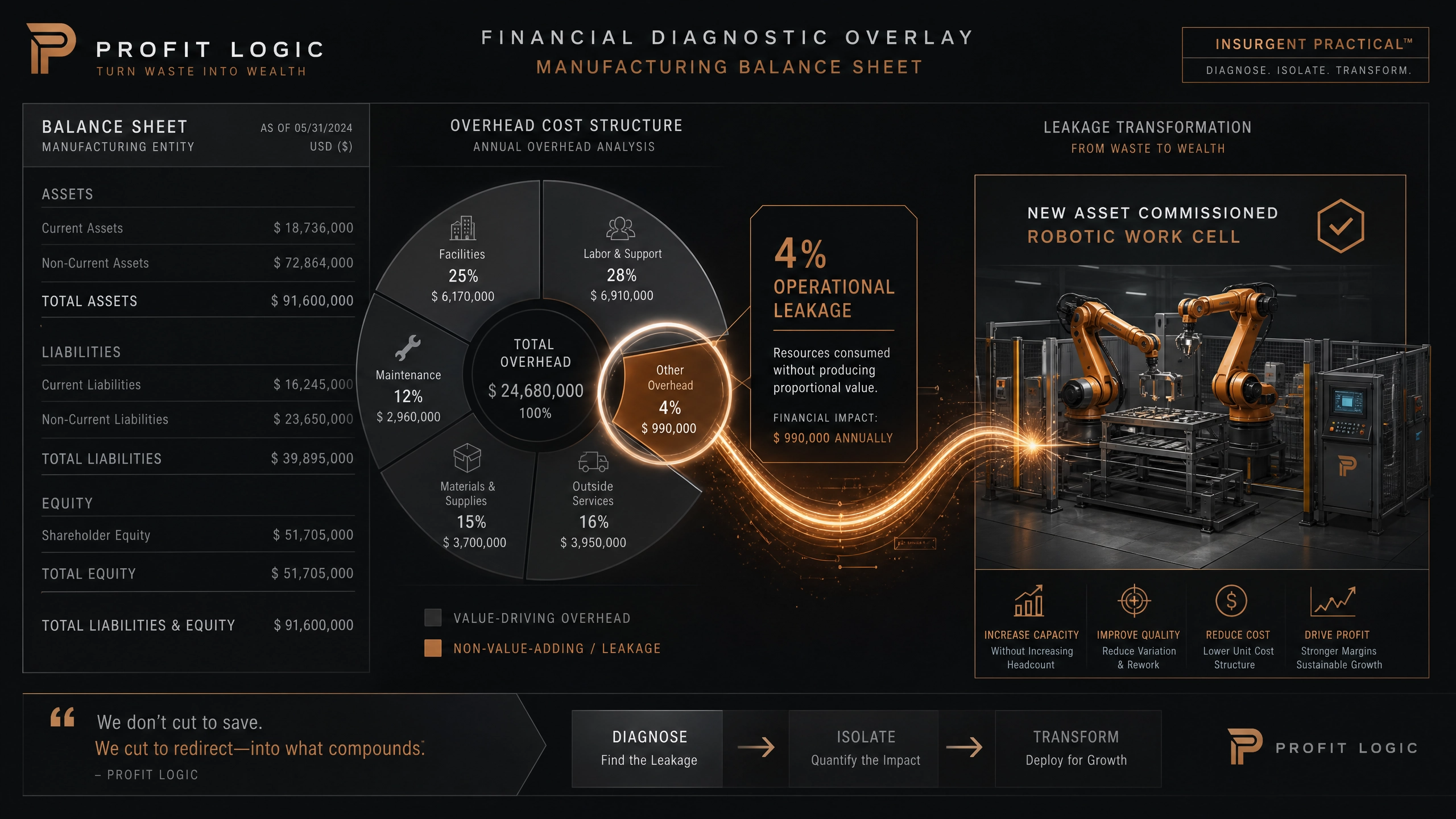
At Profit Logic, our core capability is executing a forensic diagnostic sweep across a manufacturer’s complex, non-strategic Operational Expenses (OpEx). We continuously prove that the average mid-market plant operates with an invisible, structural 4% leakage buried deep inside legacy spending categories. This waste is locked inside out-of-tolerance vendor agreements, structural maintenance contract anomalies, un-optimized industrial utility rate structures, and hidden logistics cost creeping.
This 4% is your Modernization Dividend.
On a $50 million manufacturing P&L, that 4% represents $2 million in annualized, recurring cash flow that is currently leaking straight out of your business to outside vendors and administrative variances.
+-----------------------------------------------------------------+
| SELF-FUNDING THE SMART PRODUCTION UPGRADE |
+-----------------------------------------------------------------+
| $50M Legacy Operational Spend (OpEx) |
| [====================================================] |
+-----------------------------------------------------------------+
| |
| Profit Logic Forensic Sweep Isolates 4% Waste |
| v |
| [❌ Reclaimed Leakage: $2,000,000 ] |
| |
| Capital Transformed Into Physical Automation Assets |
| v |
| [🤖 4 Commissioned FANUC / UR Robotic Cells: ~$600k ] |
| [🚚 Integrated AMR Material Loop: ~$300k ] |
| |
| = Unlocked Throughput and Multiples Without Commercial Debt |
+-----------------------------------------------------------------+
When you partner with Profit Logic to capture that 4%, you aren't just engaging in a generic cost-reduction exercise. You are activating an internal venture capital stream.
Instead of routing that reclaimed $2 million back into the general bottom line or leaving it exposed to future leakage, you redirect it directly into your Capital Expenditures budget. Suddenly, the $1 million required to deploy four FANUC machine-tending cells and a fleet of MiR AMRs is fully funded using your own organic, non-dilutive operational dollars.
You do not write a check to a commercial bank.
You do not hand over equity to an outside investor.
You simply reclaim your own capital from administrative inefficiency and apply it directly to your physical production floor.
By upgrading your floor plate using reclaimed operational dollars, you achieve two massive strategic objectives simultaneously: you expand your gross margins by wiping out legacy OpEx waste, and you permanently elevate your facility's throughput and enterprise value through automated asset ownership. The funding you need to achieve your production BHAG isn't at a bank. It is already on your P&L.
Let’s go find it.
