
Capital Isolation: Aligning Your Operational Lens with Premium M&A Value Criteria
A quiet anxiety is spreading through the executive suites of the industrial corridor this quarter. While mid-market manufacturing leadership teams have focused intensely on optimizing production floor labor and digital software infrastructure, a more volatile threat has breached the perimeter of the P&L: the escalating cost of resource instability.
This volatility is exactly why forward-looking manufacturers are shifting their capital allocation strategies. In our evaluation of the top ten strategic capital priorities for 2026, resource resilience has surged to the front of the pack. Leaders are no longer investing capital just to increase raw volume; they are prioritizing investments that defend margins against external macro-shocks.
When private equity groups and strategic corporate buyers evaluate a manufacturing asset today, they look closely at this exposure. They are no longer just asking about your customer concentration; they are judging your resource resiliency.
Crucially, this is the exact same evaluation criteria that owners and operators must apply to their own businesses today. Whether your long-term goal is to position the company for an imminent sale, or to aggressively operate and expand, viewing your facility through this objective, risk-adjusted lens is critical. If your plant operates with unmonitored energy waste, reactive machine maintenance, and baseline contract inertia with utility and raw material vendors, your earnings are structurally unstable. Buyers will apply a heavy valuation penalty—and as an operator, you are absorbing that exact same financial penalty month after month in your running overhead.
To secure your business, you must understand exactly where and why your peers are prioritizing capital in the asset layer, and deploy a self-funding mechanism to match their pace.
I. The Pillars of Resource Resilience: Where Manufacturers are Prioritizing Capital
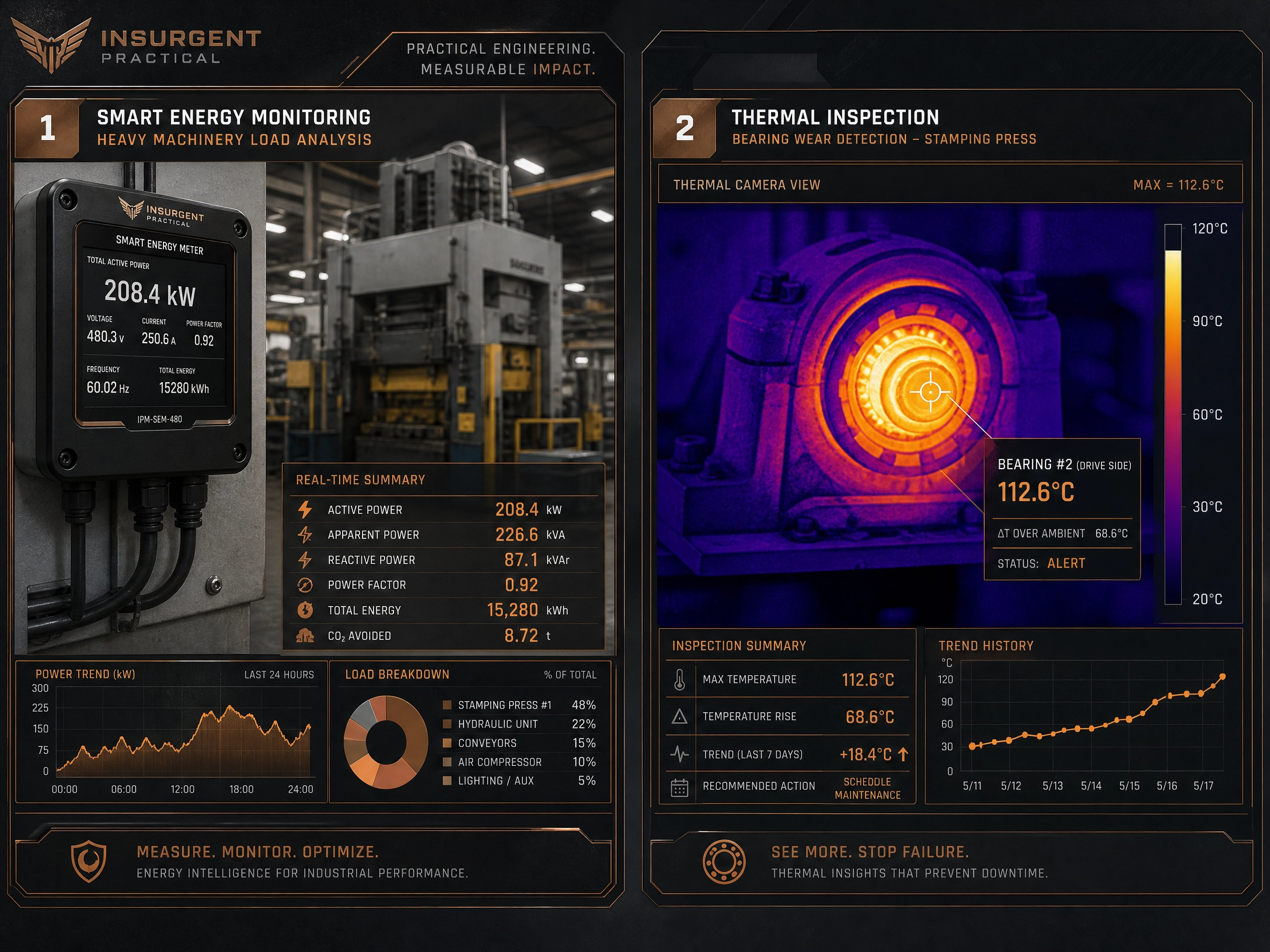
Mitigating resource volatility requires an intentional capital pivot away from traditional, reactive maintenance budgets and toward intelligent, preventative infrastructure. When mid-market leaders evaluate their highest-impact investment areas to protect their margins, they are concentrating capital into three specific, high-ROI operational pillars:
+-------------------------------------------------------------------+
| THE RESOURCE RESILIENCY PILLARS |
+-------------------------------------------------------------------+
| 1. INDUSTRIAL ENERGY MANAGEMENT SYSTEMS (EMS) |
| • Focus: Real-time power draw, peak-demand shaving, load tuning. |
| • Outcome: Insulation from grid spikes; optimized utility tiers. |
+-------------------------------------------------------------------+ | v
+-------------------------------------------------------------------+
| 2. ENTERPRISE PREDICTIVE MAINTENANCE (PdM) ARRAYS |
| • Focus: Thermal imaging, vibration sensors, fluid diagnostics. |
| • Outcome: Zero catastrophic asset failure; extended equipment lifecycle.|
+-------------------------------------------------------------------+ | v
+-------------------------------------------------------------------+
| 3. SUPPLY CHAIN TRACEABILITY & MATERIAL RECOVERY ENGINES |
| • Focus: Closed-loop scrap reclamation, automated raw tracking. |
| • Outcome: Reduced raw material dependency; mitigated input spikes.|
+-------------------------------------------------------------------+
1. Industrial Energy Management Systems (EMS)
A modern EMS goes far beyond tracking monthly utility bills. It integrates directly with sub-meters across your highest-draw equipment, providing real-time visibility into your power footprint.
Key Solutions: Systems such as Schneider Electric EcoStruxure or Honeywell Forge Energy Optimization.
Why it is Prioritized: To automatically identify "peak-demand" anomalies and optimize your operational load profile. By shifting high-draw processes outside of peak utility pricing windows, a facility can drop its base energy costs significantly without lowering production volume.
2. Enterprise Predictive Maintenance (PdM) Arrays
Waiting for a critical compressor, hydraulic press, or extrusion line to fail mid-shift is an expensive operational failure. It causes immediate downtime and forces you to pay emergency repair premiums.
Key Solutions: Advanced asset health layers built by pioneers like Emerson Automation Solutions.
Why it is Prioritized: Utilizing continuous acoustic, vibration, and thermal monitoring to flag component wear weeks before a breakdown occurs. This allows maintenance to be scheduled precisely during normal planned shutdowns, completely avoiding emergency shipping fees for parts and protecting your production schedule.
3. Supply Chain Traceability & Material Recovery Engines
When primary commodity prices spike, your waste stream becomes an un-mined asset. Advanced tracking systems monitor raw material consumption and scrap generation at every stage of the line.
Why it is Prioritized: Implementing highly precise, closed-loop scrap recovery and material traceability ensures that every pound of aluminum, copper, or polymer scrap is instantly captured, segregated, and recycled back into production or sold at maximum market value—significantly reducing your dependence on expensive virgin raw material inputs.
II. The Proof in the P&L: Public Use Cases
The financial returns on these specific investment areas are clear and documented across the industrial sector. These platforms deliver measurable improvements to your bottom line, making them highly attractive to both active operators and M&A buyers:
The Predictive Maintenance Dividend: A major automotive component fabricator integrated continuous vibration and thermal sensor arrays across its heavy stamping presses. Within nine months of implementation, the predictive system flagged a subtle bearing misalignment in a primary press that was invisible to manual inspection. By executing a controlled, planned repair over a standard weekend maintenance window, the facility avoided an estimated $180,000 in catastrophic mid-shift downtime and emergency asset replacement costs.
The Resource Optimization Leverage: A mid-market advanced materials plant deploying Schneider Electric EcoStruxure architecture targeted its energy-intensive curing ovens. By utilizing automated sub-metering data to balance the thermal loads and shift startup cycles by just 45 minutes, the facility cut its monthly peak-demand surcharges by 22%, while completely insulating its production schedule from regional grid strain.
III. The Marketplace Reality: The Real Cost to Insulate
The operational case for these priorities is clear. Public industrial data verifies that an enterprise deployment of automated predictive maintenance and energy optimization can expand your baseline capacity by up to 15% while dropping non-strategic utility overhead by a quarter.
Yet, mid-market CFOs frequently delay these critical deployments due to the high upfront capital expenditure required.
To install comprehensive sub-metering, purchase specialized industrial IoT sensor arrays, and integrate unified EMS/PdM software platforms across a multi-line facility, the capital requirements are substantial. Industry benchmarks show that fully integrated, site-wide engineering and commissioning premiums—including custom PLC integration, sensor calibration, network architecture mapping, and staff training—routinely bring the total cost of a comprehensive resource resilience project to $400,000 to $1,200,000.
Faced with this heavy financial requirement, many executive teams choose to wait. They look at current commercial borrowing rates and decide to accept the volatility of utility spikes rather than taking on expensive bank debt.
However, choosing to wait is a passive strategy that exposes your business to significant risk. Every month you delay resource optimization is a month your margins remain unprotected against sudden market spikes, and a month that your enterprise valuation remains suppressed under an objective M&A review.
IV. The Profit Logic Bridge: Activating Shared Success
You do not need to look outward for capital to fund this asset modernization. The funding required to build an insulated, resource-resilient plant is already leaking out of your P&L through the very operational and vendor categories you pay for every month.
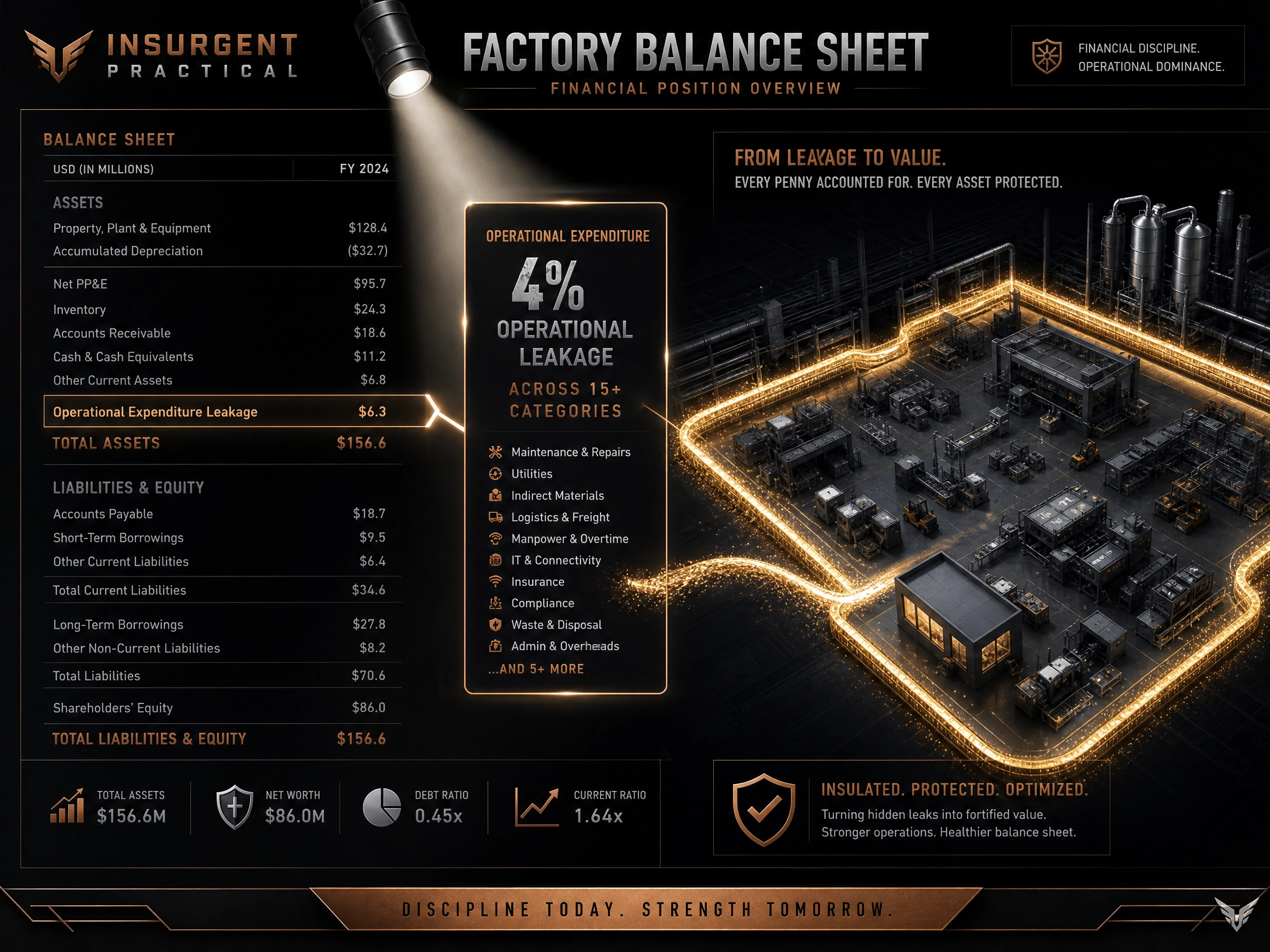
At Profit Logic, our core capability is executing an exhaustive forensic diagnostic sweep across more than 15 complex, non-strategic Operational Expenses (OpEx). We look far beyond basic utilities, running a comprehensive audit across administrative, logistical, and operational categories to isolate an invisible, structural leakage that typically averages 4% of a manufacturer's total operating spend. This includes hidden inefficiencies within complex industrial utility structures, waste stream management, shipping and freight, telecom, treasury fees, maintenance contract fidelity, and asset lifecycle compliance.
This 4% is your Modernization Dividend. On a $50 million manufacturing P&L, for example, this forensic sweep uncovers an indicative $2,000,000 in annualized, recurring cash flow that is currently being lost to vendor profit margins and billing errors.
+-----------------------------------------------------------------+
| SELF-FUNDING THE RESOURCE RESILIENCY PLATFORM |
+-----------------------------------------------------------------+
| $50M Legacy Operational Spend (OpEx) |
| [====================================================] |
+-----------------------------------------------------------------+
| |
| Profit Logic Forensic Sweep Isolates 4% Waste |
| v |
| [❌ Reclaimed OpEx Leakage: Indicative $2,000,000 ] |
| |
| Capital Transformed Into Asset & Resource Protection |
| v |
| [🔌 Integrated Schneider / Honeywell EMS Layer: ~$400k ] |
| [🛠️ Unified Emerson Predictive PdM Arrays: ~$500k ] |
| |
| = Insulated Margins and Premium Valuation Multiples |
+-----------------------------------------------------------------+
We solve this capitalization friction through a shared success model. Our engagements are aligned completely with the outcome, meaning your modernization initiative requires zero upfront capital outlay from your current operational budget. This model ensures the entire cost-recovery process is a net-zero cost to your organization until we deliver a net-positive financial result.
By engaging Profit Logic, you can act as your own internal capital fund. You use the liberated operational waste to fully fund the deployment of advanced energy optimization and predictive maintenance arrays. You do not add a new liability to your balance sheet; you reclaim a margin.
Whether your goal is an aggressive internal expansion over the next five years or optimizing the business for a premium exit multiple, looking at your operation through this value-driven lens changes the game. You insulate your facility from utility shocks, eliminate catastrophic downtime, and lift your business into a premium valuation tier using the very waste your legacy systems are currently failing to track. The capital is already in the building. Let’s go find it.
