
Capital Sovereignty: Financing the Transition to Agentic Manufacturing
The North American industrial corridor has entered a period of profound structural rebalancing. As of April 2026, the legislative and technological landscape is no longer signaling a gradual evolution; it is demanding a total pivot toward Capital Sovereignty. The passage of H.R. 1 (The One Big Beautiful Bill Act) in the United States and the activation of the $4B BDC Defense Platform in Canada have introduced a surge of liquidity and tax certainty [2.1, 1.1]. Yet, for many mid-market manufacturers, there is a mounting "Modernization Gap." The barrier is not a lack of vision or the absence of domestic opportunity, but the inability to fund the transition from legacy automation to fully autonomous, agentic environments.
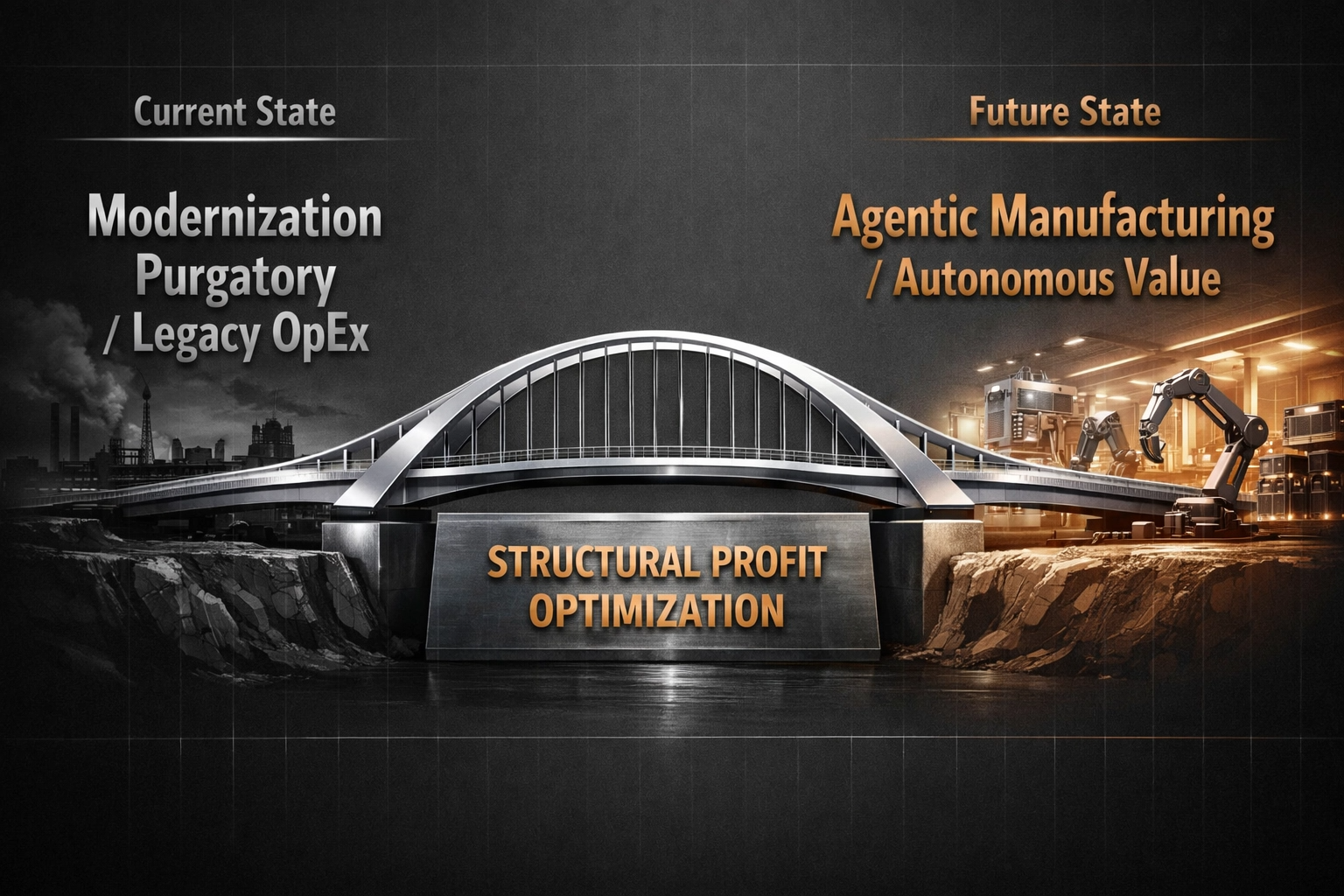
The shift is visible in the shop floor displacement data released this week. While the media remains fixated on white-collar AI, the production floor is seeing "99% imminent automation risk" for roles like patternmakers and machine operators as physical AI moves into unstructured environments [4.1]. This is matched by Samsung’s global roadmap to transition to "AI-Driven Factories" by 2030, powered by agents that autonomously execute quality control and logistics [5.1]. In this environment, "staying the course" is no longer a conservative strategy—it is a choice for obsolescence.
The central paradox for the 2026 CFO is the Infrastructure/AI Funding Gap.
Current data reveals that up to 30% of enterprise cloud spending is functionally wasteful, yet oversight has only recently reached the Board level [3.1]. In a landscape where Boeing is committing $36M to Winnipeg’s robotics cluster and U.S. manufacturers are leveraging 100% bonus depreciation under H.R. 1 to reshore, allowing 30 cents of every digital dollar to leak is a strategic failure [6.2, 2.1].
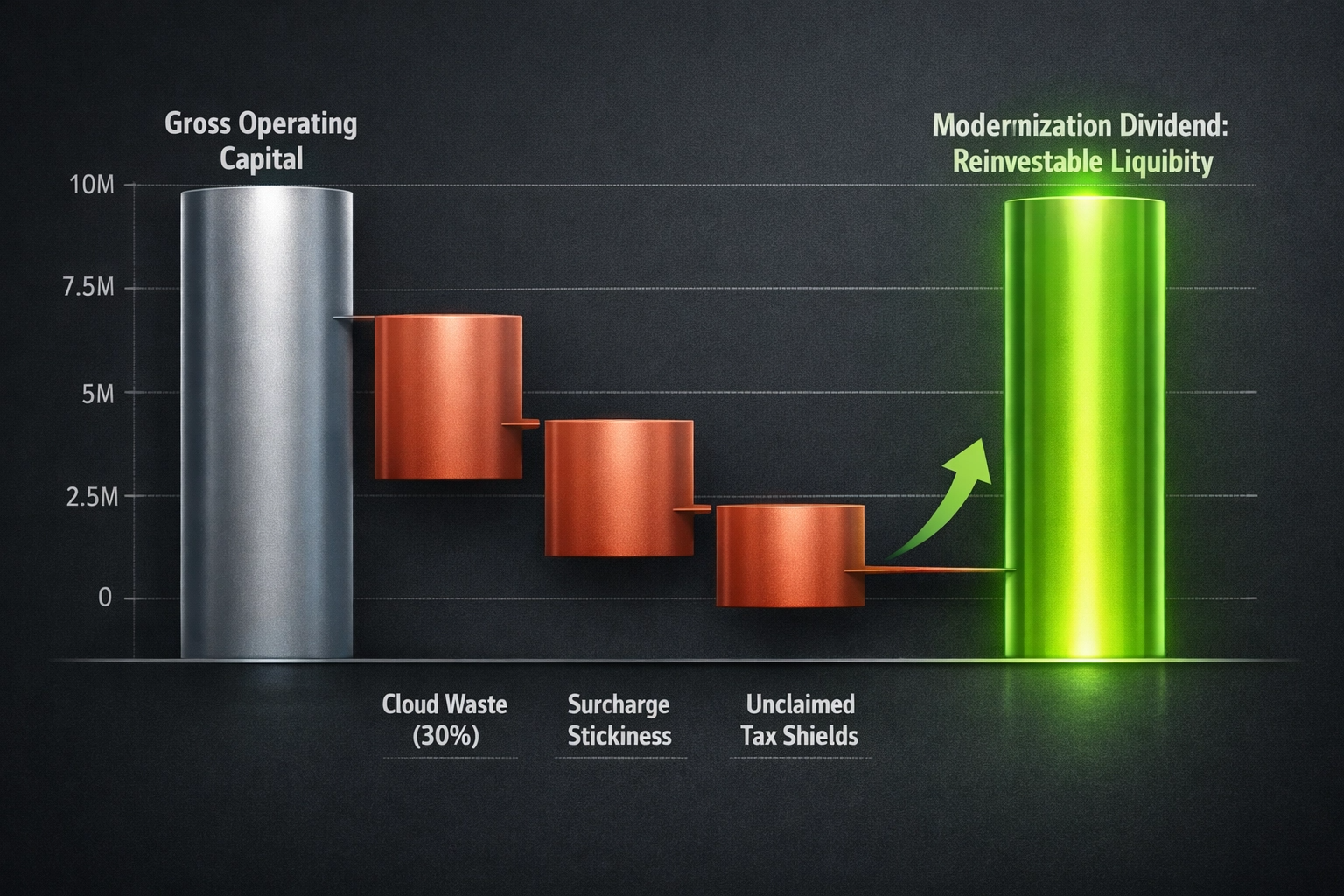
This waste is not merely an operational nuisance; it is the Maintenance Tax that prevents firms from achieving the "Modernization Dividend"—the ability to fund Tier-1 automation requirements using the very waste they eliminate from their own P&L.
Furthermore, the operational environment is tightening through "Surcharge Stickiness." As the Canadian federal fuel tax suspension takes effect this Monday, April 20th, a projected $2.4B in relief will enter the market [5.2]. However, without forensic governance, this windfall is frequently absorbed by vendor margins as surcharges fail to recede in tandem with tax drops. This is compounded by high-scrutiny compliance environments, such as the CRA’s crackdown on "Commercial Purpose" in SR&ED claims [1.2].
True Structural Profit Optimization (SPO) is the governance layer required to navigate these deltas. It is the clinical identification and capture of trapped capital—from digital infrastructure to contract fidelity—to provide the non-dilutive funding required for sovereignty.
In 2026, the leaders are not those who seek new debt, but those who possess the forensic discipline to reclaim the capital they are already spending.
[1.1] BDC Defense Platform: Mobilization of $4B in capital for Canadian defense SMEs to ensure 70% domestic procurement.
[1.2] CRA Regulatory Bulletin: April 2026 update on SR&ED "Commercial Purpose" scrutiny and Gross Negligence Penalties.
[2.1] H.R. 1 (OBBBA): U.S. legislation enabling 100% bonus depreciation and immediate R&D expensing, reducing machinery after-tax costs by ~21%.
[3.1] CFO Dive/Azul Report: Published April 10, 2026; identifies 30% cloud waste and rising Board-level oversight.
[4.1] Planera Automation Index: April 2026 report identifying 99% risk for physical production roles.
[5.1] Samsung Global Strategy: Official 2030 roadmap for "Agentic AI-Driven Factories."
[5.2] Fuel Tax Suspension: Federal decree effective April 20, 2026, injecting $2.4B in relief.
[6.2] Boeing Investment: $36M CAD commitment to Winnipeg aerospace R&D and process automation.
