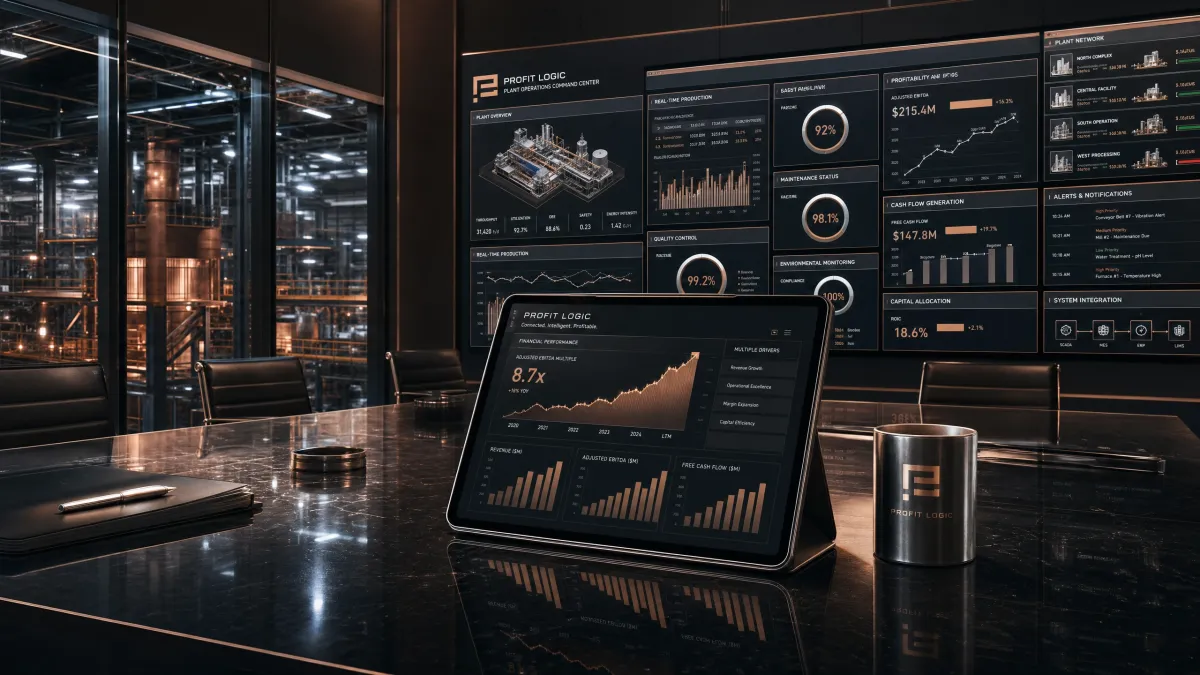
The Illusion of Democratic Budgeting: Data Sovereignty and the Cost of SaaS Decay
Every mid-market manufacturing boardroom across the industrial corridor likes to congratulate itself on operational discipline. You look at your strict CapEx approval chains, your rigorous inventory turn tracking, and your hard limits on direct labor overtime.
Yet, beneath the surface of your seemingly optimized P&L, a silent margin erosion is actively compromising your enterprise valuation.
It is driven by a management failure I call Democratic Budgeting.
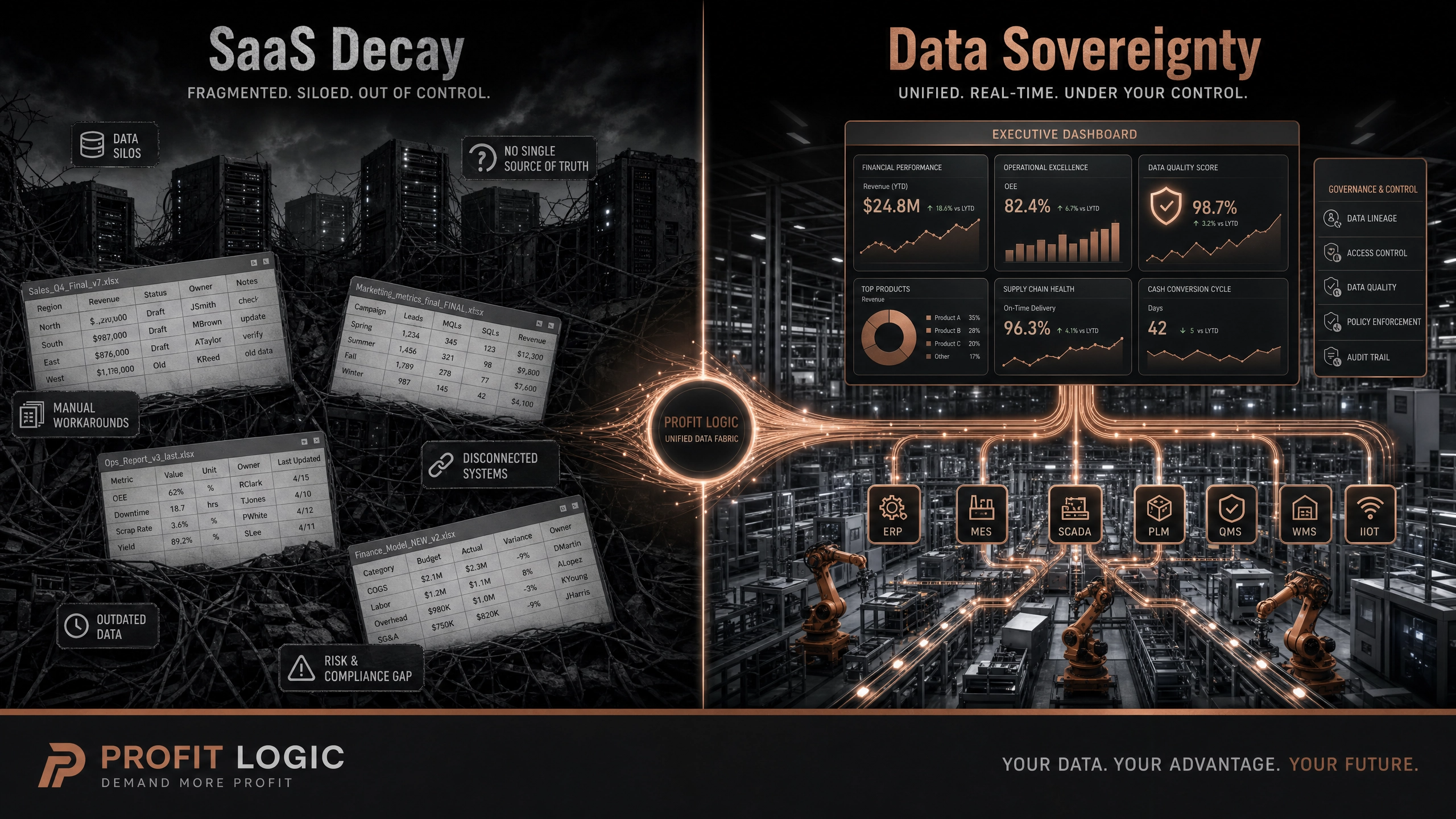
Democratic Budgeting occurs when a leadership team treats specialized operational software, technology licenses, and digital service infrastructure as localized departmental utility bills rather than critical corporate assets requiring forensic governance. Because individual department heads are given autonomous authority to procure "point solutions" to put out immediate fires, the modern manufacturing plant ends up operating on a digital patchwork of fragmented, unlinked silo spreadsheets and redundant systems.
As we press into the high-stakes mergers and acquisitions (M&A) market, corporate buyers and private equity groups are no longer ignoring this digital clutter. They are pricing it ruthlessly.
In an asset-heavy economy, data opacity is treated as a severe execution risk. If your facility relies on fragmented systems, unmonitored service utilization, and manual data transcription to understand its true cost-to-serve, your valuation multiple is being discounted. To protect your equity, you must transition from a collection of isolated software buyers to a sovereign technology platform.
I. The Anatomy of Data Opacity: The True Cost of SaaS Decay
When a manufacturing plant grows without centralized data governance, it invariably succumbs to SaaS Decay. This isn't high-level theoretical waste; it is a concrete cash drain that directly reduces your monthly EBITDA.
Consider how Democratic Budgeting manifests across a typical $100 million manufacturing operation:
+-------------------------------------------------------------------+
| THE DIGITAL SILO REVENUE EXTRACTION |
+-------------------------------------------------------------------+
| THE OPERATIONS FLOOR: UNLINKED SCADA / MES |
| • Legacy equipment data trapped in proprietary localized panels. |
| • Outcome: Manual transcription errors; cycle time lag. |
+-------------------------------------------------------------------+ | v
+-------------------------------------------------------------------+
| THE MATERIAL DOCK: INVENTORY MANAGEMENT SILOS |
| • Procurement utilizes separate point solutions for kitting. |
| • Outcome: Excess inventory safety-buffers; frozen capital. |
+-------------------------------------------------------------------+ | v
+-------------------------------------------------------------------+
| THE C-SUITE: THE EXECUTIVE SPREADSHEET ILLUSION |
| • Finance manually aggregates data via conflicting spreadsheets. |
| • Outcome: Backward-looking decision lagging; invisible leakage. |
+-------------------------------------------------------------------+
The financial toll of this fragmentation is immense. Because different departments are running separate, uncoordinated platforms, the business pays a continuous "integration tax" in the form of manual labor hours wasted just trying to get systems to speak to one another.
More critically, individual license structure stagnation sets in. Our forensic reviews consistently reveal that mid-market manufacturers pay for seats, modules, and platform access tiers that have been completely abandoned by departed employees or made redundant by subsequent software implementations.
This is the hidden tax of "Legacy Tech": you aren't just paying for what you use; you are actively subsidizing vendor profit margins through unmonitored contract inertia.
II. The Core Platforms: Achieving Data Sovereignty
To eliminate the valuation discount applied by modern M&A buyers, mid-market manufacturers must centralize their digital architecture into an ironclad Data Sovereignty Platform. This requires migrating away from isolated point solutions and embedding interconnected enterprise layers:
1. Advanced Manufacturing Execution Systems (MES)
An enterprise-grade MES acts as the central nervous system of the facility, linking physical floor assets directly with top-floor financial metrics.
Key Solutions: Systems such as Rockwell Automation FactoryTalk or Siemens MindSphere.
The Strategic Benefit: Capturing real-time production telemetry directly from the machine PLC level. This eliminates manual logs, tracks precise machine cycle times, and instantly flags micro-downtime events before they cascade into macro-throughput bottlenecks.
2. Connected Industrial IoT (IIoT) & Predictive Analytics
Instead of waiting for an asset to catastrophically fail mid-shift, IIoT sensors capture vibration, thermal data, and electrical draw, feeding these metrics into unified predictive analytics models.
Key Solutions: Enterprise data layers engineered by PTC ThingWorx or deployed through SAP Digital Manufacturing.
The Strategic Benefit: Transforming maintenance from a reactive, chaotic cost center into a scheduled, highly predictable governance discipline.
III. The Marketplace Reality: The Real Cost to Connect
The return on investment for centralized data sovereignty is undeniable. Public data verifies that integrating an advanced MES layer like Siemens or Rockwell Automation can unlock up to a 20% increase in hidden plant capacity simply by eliminating tracking latency and manual operational blind spots.
But the implementation barrier is not a lack of executive willingness; it is the sheer weight of the upfront cash outlay.
To deploy a fully integrated MES and IIoT data layer across a multi-line facility in the current market, the pricing breaks down into a severe capital requirement:
Software Licensing & SaaS Access: Enterprise agreements for unified platforms scale rapidly based on data nodes and user connections.
Integration, Mapping, and Governance Premiums: Custom PLC mapping, API engineering, legacy database migration, and staff training routinely push the total implementation cost of a true digital transformation to $500,000 to $1,500,000.
When faced with this seven-figure capital requirement, most mid-market CFOs delay the upgrade. They look at the high cost of commercial debt and decide that living with fragmented spreadsheets is safer than stressing their debt-service coverage ratios.
But that delay is a major strategic miscalculation. Every quarter you run an opaque operation is a quarter your margins are eroded by invisible operational variances and un-reclaimed overhead.
IV. The Profit Logic Bridge: Activating Success-Based Stewardship
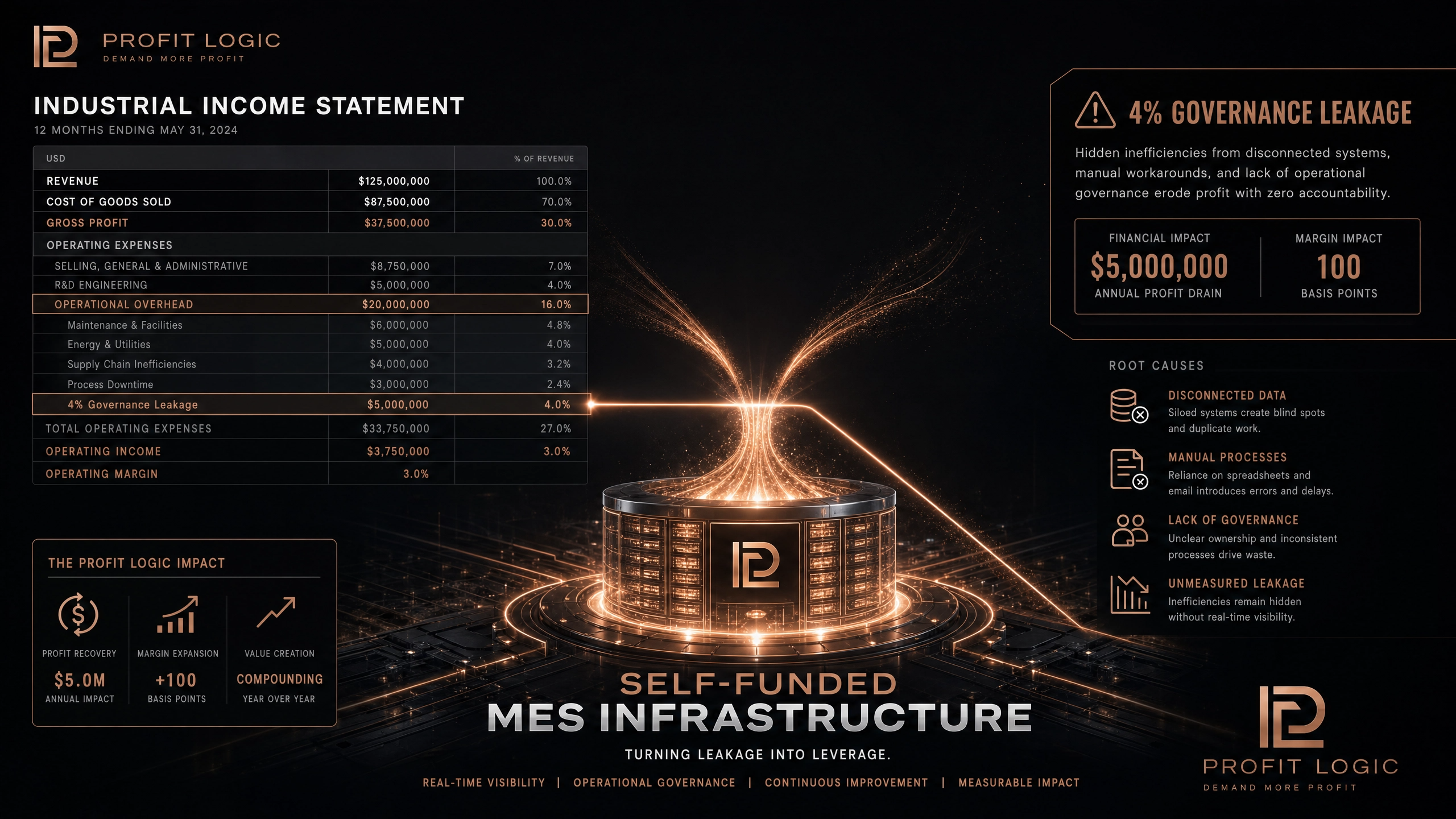
You do not need to look outward for capital to fund your digital modernization. The cash required to build an audit-proof, sovereign data platform is already leaking out of your P&L through the very operational governance silos we intend to eliminate.
At Profit Logic, our core capability is executing a forensic diagnostic sweep across a manufacturer's legacy Operational Expenses (OpEx). We consistently isolate an invisible, structural 4% leakage deeply embedded in non-strategic cost categories—specifically targeting the dark corners of Operational Governance, software licensing, administrative overcharges, and commercial contract fidelity.
This 4% is your Modernization Dividend. On a $50 million manufacturing P&L, this forensic sweep isolates $2,000,000 in annualized, recurring cash flow that is currently being forfeited to vendor profit margins.
+-----------------------------------------------------------------+
| SELF-FUNDING THE DIGITAL SOVEREIGNTY PLATFORM |
+-----------------------------------------------------------------+
| $50M Legacy Operational Spend (OpEx) |
| [====================================================] |
+-----------------------------------------------------------------+
| |
| Profit Logic Forensic Sweep Isolates 4% Waste |
| v |
| [❌ Reclaimed Governance Leakage: $2,000,000 ] |
| |
| Capital Transformed Into Enterprise Data Sovereignty |
| v |
| [💻 Integrated Rockwell / Siemens MES Layer: ~$600k ] |
| [🌐 Unified PTC ThingWorx IIOT Architecture: ~$400k ] |
| |
| = Eradicated SaaS Decay and Premium Valuation Multiples |
+-----------------------------------------------------------------+
We solve this liquidity gap through an exclusive contingency partnership model. Our engagement is entirely success-fee based, funded wholly out of the ongoing capture of verified savings and refunds over a 36-month term. This ensures the entire modernization initiative requires zero upfront capital outlay, making our forensic integration a net-zero cost to your organization until we produce a net-positive financial result.
By deploying our intellectual property, you effectively act as your own internal venture capital fund. You use the liberated operational waste to fully fund the deployment of enterprise-grade software arrays. You do not add a new liability to your balance sheet; you reclaim a margin. You eliminate SaaS decay, erase your data blind spots, and lift your business into a premium valuation tier using the very waste your legacy systems are currently failing to track. The capital is already in the building. Let’s go find it.
