
The Growth Paradox: Why Record Top-Line Guidance Is Crushing Free Cash Flow
There is a contradiction showing up across recent earnings disclosures from North American manufacturers and industrial supply chains. Companies are raising their revenue outlooks while, at the same time, cutting their expectations for free cash flow.
Demand is growing. Order backlogs are building. Executive teams are winning major new program awards. But the cash needed to deliver on that growth is disappearing faster than many businesses can replace it:
Celestica lifted its full-year revenue expectations to $21.0B while lowering its free cash flow outlook from $600M to $460M. Management directly cited the inventory buffer and working capital burden required to support hyperscaler programs ramping into 2027.
Jabil raised its annual revenue targets while trimming near-term free cash flow expectations to absorb the inventory pre-funding, tooling cycles, and operational ramps tied to AI infrastructure and power distribution lines.
Sanmina reported accelerating program backlogs and raised its top-line targets, while management pointed to working capital absorption and longer component holding periods across complex industrial lines as a drag on quarterly cash conversion.
Linamar reported growing order books across its mobility and industrial segments, yet guided toward weaker cash conversion as upfront retooling, prototype scrap, and raw material safety stock consumed cash ahead of full-rate production.
Flex increased its full-year sales guidance following multi-year program wins, but tempered near-term cash conversion expectations because of large-scale component staging, buffer stock requirements, and upfront supply-chain capital commitments.
The message across these disclosures is hard to miss. The biggest operational threat facing manufacturers today is not a lack of customer demand. It is the Growth Paradox: ramping new production lines, onboarding enterprise programs, and fulfilling larger orders can consume cash much faster than baseline operating margins can replenish it.
The Working Capital Trap in Modern Manufacturing
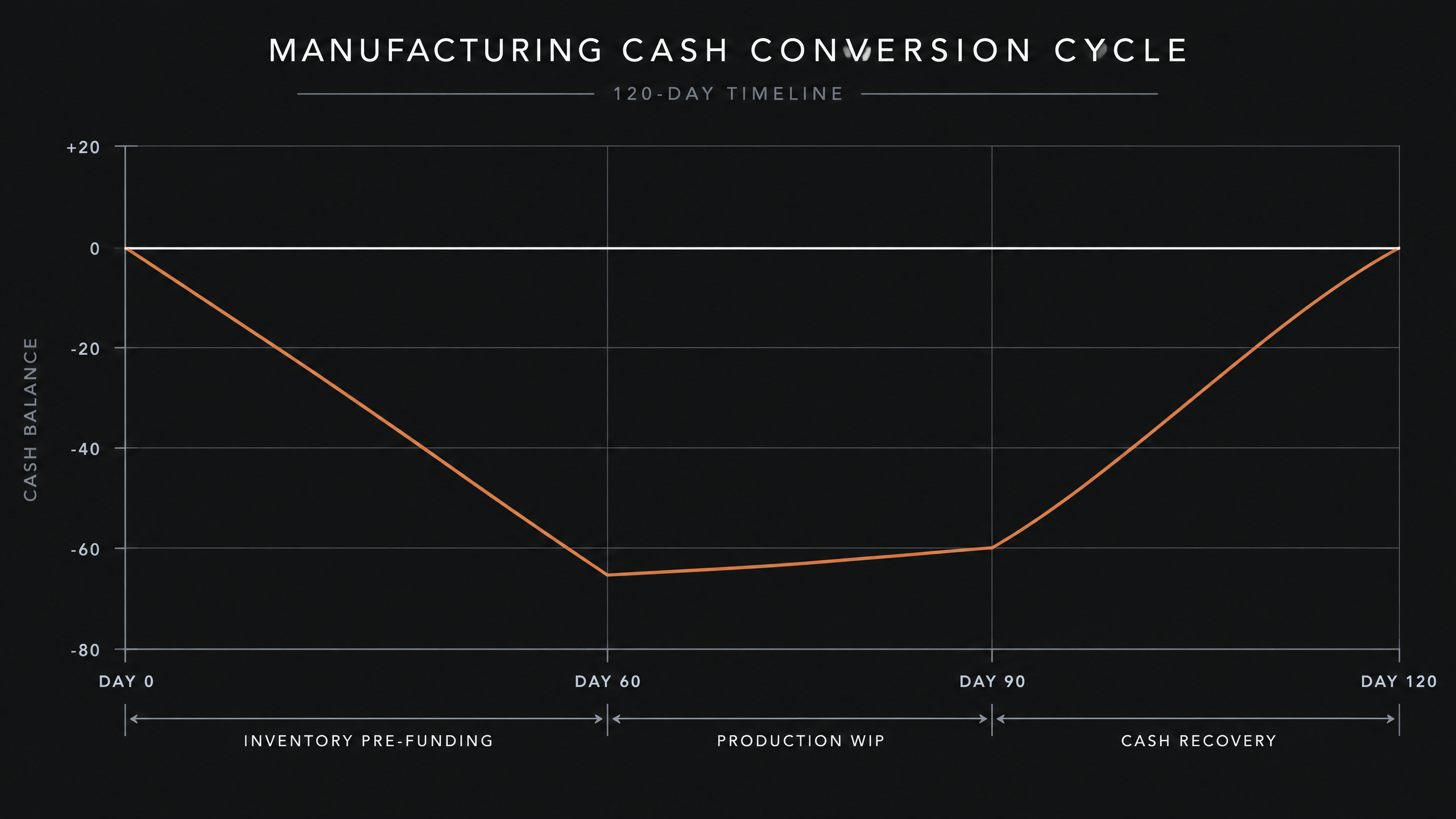
When production accelerates, the financial supply chain starts to feel the pressure almost immediately. Cash goes out well before the related customer payment comes in:
Inventory Pre-Funding: Raw metals, resins, components, packaging, and sub-assemblies often need to be purchased 60 to 120 days before final assembly.
Production WIP Drain: Direct labor, tooling cycles, machine maintenance, staging freight, and plant utility loads pull cash from the business every two weeks.
Receivables Lag: Prime contractors, automotive OEMs, and enterprise customers often continue to require 60-to-90-day payment terms.
The faster a plant scales to meet demand, the deeper and wider that liquidity trough becomes.
Large public companies can often bridge the gap by drawing on revolving credit facilities, issuing convertible debt, or using commercial paper. Independent manufacturers have fewer attractive options. With commercial interest rates still elevated and regional lenders tightening covenants, borrowing to fund an operational ramp can consume gross margin long before the customer invoices are paid.
That is the uncomfortable part of growth. The order may be profitable on paper, but the business still has to finance the journey from purchase order to cash collection.
The Hidden Drain: Indirect Overhead Inertia
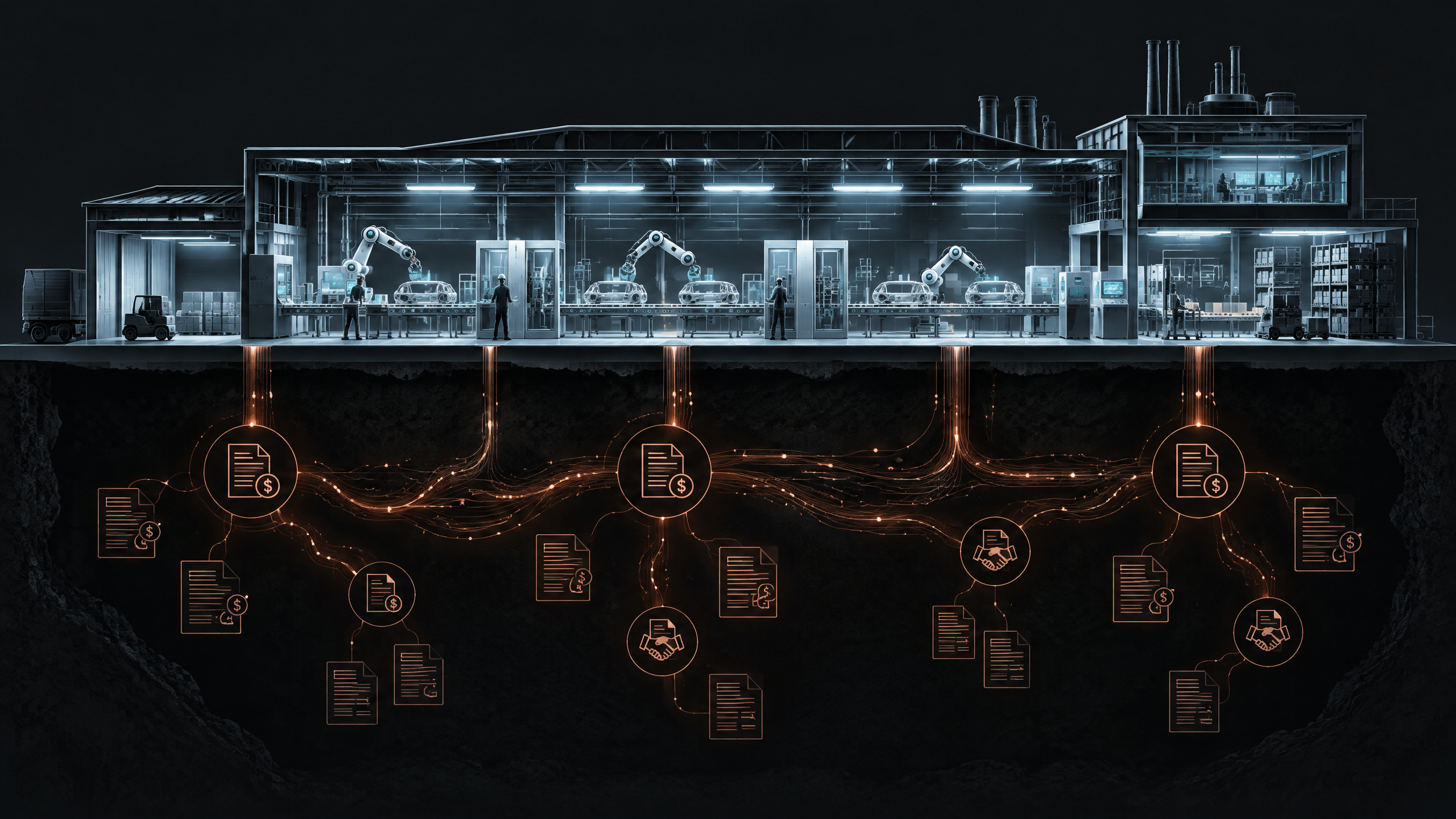
While production and finance teams are focused on managing the working capital demands of a direct program ramp, another cash leak can continue quietly in the background: indirect operational spend.
When a plant is running at capacity to meet upgraded delivery schedules, executive attention goes where it has to go. Teams are dealing with bill-of-materials sourcing, shift schedules, machine uptime, quality control, and customer commitments. No CFO, VP of Finance, or Plant Manager has much time left to review every line item on a peripheral vendor invoice.
Because these categories sit outside the core production process, they are especially vulnerable to contract inertia. Over a typical two-to-three-year period:
Less Than Truckload (LTL) and Small Package Shipping (SPS) fuel surcharges can drift upward without anyone challenging them.
Volume discount tiers can fail to trigger automatically as production volume expands.
Industrial waste, packaging, compressed gas, telecom, uniform, and merchant processing fees can quietly accumulate unverified ancillary surcharges.
The result is an unbudgeted Maintenance Tax. It can siphon up to 4% of top-line revenue out of the business every month through invoices that no one has the time to audit.
When free cash flow is already under pressure from inventory builds and production staging, that 4% leakage is not simply a cost of doing business. It is the non-dilutive liquidity that could help cushion the ramp.
Reclaiming Cash Flow from Within
Solving the Growth Paradox does not necessarily require expensive commercial debt, dilutive equity, or waiting for customer receivables to arrive. It starts with finding the cash already trapped inside the indirect cost structure.
For a manufacturer generating substantial top-line revenue, an unexamined 4% operational leakage can represent millions in trapped capital spread across dozens of indirect vendor agreements.
Recovering that capital can change the balance sheet in three important ways:
The Cash Is Non-Dilutive: Recovered margin flows directly into operating cash flow without debt service, interest drag, or restrictive banking covenants.
The Relief Does Not Touch Production: Optimizing freight profiles, waste contracts, packaging agreements, and processing fees does not require changing equipment configurations, disrupting the shop floor, or putting customer delivery commitments at risk.
The Margin Holds Over Time: Active contract governance helps keep supplier pricing aligned over multi-year terms and prevents rate creep from eroding the newly recovered baseline.
This is not about cutting the capabilities that help a plant operate. It is about making sure the business is paying what its contracts and market conditions actually support.
Fund Your Growth from the Inside Out
Winning major customer programs and increasing sales guidance should strengthen enterprise value, not put unnecessary strain on the balance sheet.
If your organization is ramping production for major delivery cycles, do not let unmonitored vendor agreements quietly consume the cash required to execute. The working capital needed to protect liquidity and fund expansion may already be moving through the back office.
You may not need outside financing to support your growth. You may simply need to stop allowing vendor inertia to bleed the cash out of it.
