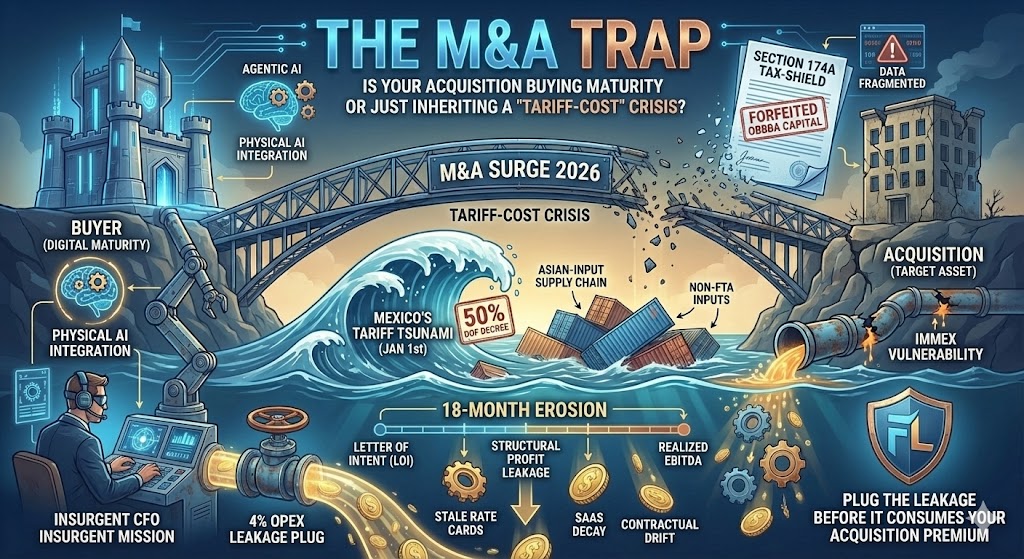
The M&A Trap: Is Your Acquisition Buying Maturity or Just Inheriting a "Tariff-Cost" Crisis?
Mid-market M&A is expected to surge in 2026, but the objective has shifted. You aren't just buying market share; you are buying the digital maturity needed to survive the Age of Agentic AI.
However, there is a dangerous gap between the Letter of Intent (LOI) and realized EBITDA. As Mexico’s January 1st "Tariff Tsunami" takes hold, many acquirers are realizing too late that their new asset is anchored to an Asian-input supply chain that has effectively been taxed out of existence.
The 18-Month Erosion
Most deals fail to hit their 18-month targets not because of poor sales, but because of Structural Profit Leakage. In the current trade environment, inheriting an un-governed P&L means inheriting:
The IMMEX Vulnerability: Targets with Mexican operations (Maquiladoras) that relied on non-FTA Asian inputs just saw their margins decimated by the 50% DOF Decree. If your due diligence didn't model a 100% shift to North American sourcing, your valuation is a fiction (Source 1.2).
Agentic Technical Debt: You aren't just inheriting old software; you're inheriting a system that lacks "agency." While leaders use Agentic AI to auto-re-route supply chains during trade shifts, your target is still manually reconciling freight invoices from three months ago.
Forfeited OBBBA Capital: To justify 2026 multiples, you likely planned to leverage Section 174A to immediately expense modernization costs. But if the target’s P&L is un-governed and data-fragmented, you cannot provide the process-linked documentation the IRS now requires (Source 2.1). You are effectively forfeiting the very tax-shield that funded the deal.
The Insurgent CFO’s Mission
Leading CFOs are moving away from "Democratic Budgeting." Instead, they are launching Insurgent Missions—forensically attacking the 4% internal OpEx leakage (stale rate cards, SaaS decay, contractual drift) to fund the "Physical AI" integration that the deal thesis promised.
The Verdict: If you are "buying maturity" but neglecting Structural Profit Optimization, you aren't scaling a leader—you are subsidizing a laggard. Plug the leakage before it consumes your acquisition premium.
[1] Source 1.2: The Mexican "Tariff Tsunami" Decree. Refers to the Diario Oficial de la Federación (DOF) decree effective January 1, 2026, which implemented a massive "Most Favored Nation" (MFN) tariff hike on 1,463 product categories from non-FTA countries. Notably, the decree complicates the "Lesser of the Two" rule for IMMEX/Maquiladoras, often requiring companies to pay the delta between non-FTA input duties and USMCA destination duties—a specific "backdoor" liability that can erode up to 35-50% of the margin on steel, aluminum, and automotive components.
[2] Source 2.1: IRS Section 174A Procedural Guidance (Rev. Proc. 2025-28). Under the One Big Beautiful Bill Act (OBBBA), Section 174A restores immediate expensing for domestic R&D and modernization. However, Revenue Procedure 2025-28 stipulates rigorous "Linkage Governance." To qualify for the tax-shield, manufacturers must move beyond aggregate accounting and provide granular, digital documentation that links wage hours, supplies, and tooling directly to discrete process improvements. Failure to maintain this "data-to-dollar" linkage effectively makes the modernization expense non-deductible in an audit.
