The Workforce is the Strategy: Funding the "Execution Era" through Forensic Liquidity
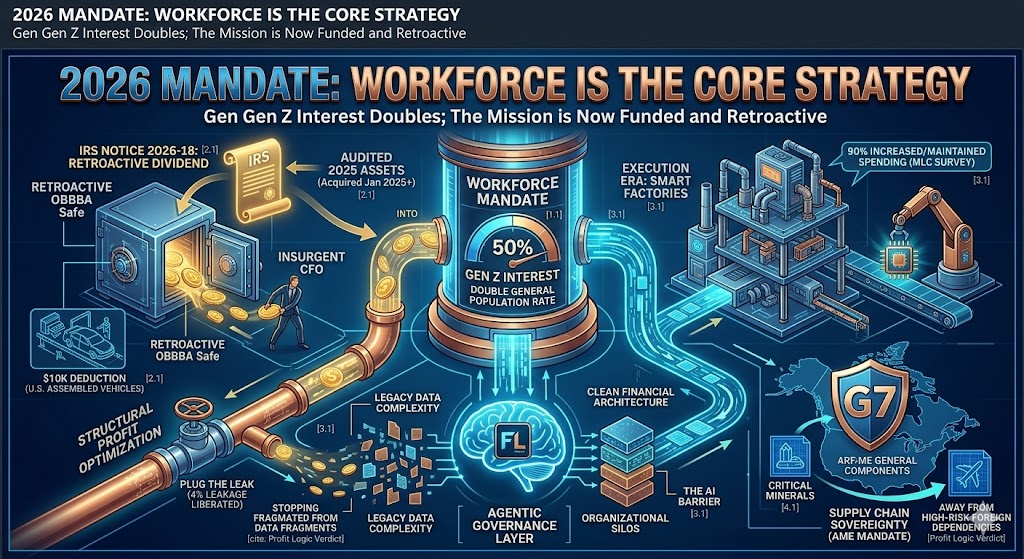
On February 26, 2026, in Dallas, Manufacturing Institute President Carolyn Lee delivered a mandate that redefined the C-Suite priority list for the remainder of the decade: Workforce is no longer a side issue; it is the core industrial strategy [1.1]. For years, the industry has braced for a talent cliff. However, new data from a landmark Harris Poll suggests a significant pivot is occurring: 50% of Gen Z is now expressing interest in skilled trade careers—double the rate of the general population.
The talent is finally looking at manufacturing. The challenge for leadership in 2026 is no longer just "finding" people; it is building the high-margin, digitally mature organizations capable of retaining them.
The Retroactive Capital Event: Auditing 2025 for 2026 Growth
Building the "Launchpad Careers" that the next generation demands requires a level of capital that many mid-market firms feel they lack. However, a significant liquidity event was triggered on February 26, 2026, when new tax guidance—IRS Notice 2026-18—confirmed that the One Big Beautiful Bill Act (OBBBA) bonus depreciation is retroactive to assets acquired as of mid-January 2025 [2.1].
This is a critical moment for the "Insurgent" CFO. If an organization is not forensically auditing its 2025 CapEx against these retroactive rules today, it is effectively forfeiting a refund that could fund its entire 2026 modernization roadmap. This includes the new $10,000 deduction for car loan interest on U.S.-assembled vehicles—a subtle but powerful incentive designed to bolster domestic assembly lines and reward the domestic workforce.
Supply Chain Sovereignty: The National Security Mandate
The pressure to modernize isn't just coming from the workforce; it’s coming from the G7. At the AME Portland Summit on February 25-26, the conversation moved beyond "resilience" to Supply Chain Sovereignty [4.1]. Following Canada’s new Defense Industrial Strategy, there is now a coordinated push for G7 allies to secure domestic processing for critical minerals and aerospace components. Resilience is no longer a "nice-to-have" logistics goal; it is a national security requirement. But sovereignty cannot be built on a leaky P&L. Manufacturers cannot transition to domestic sourcing if their margins are being eroded by "Invisible Taxes"—un-governed vendor contracts, facility waste, and stagnant shipping math.
The Bottleneck: Data Complexity in the Execution Era
The February 2026 Manufacturing Leadership Council (MLC) survey confirms that 90% of manufacturers intend to maintain or increase smart factory spending [3.1]. Yet, while optimism remains high at 67%, the primary barrier to scaling AI is not the cost of the technology itself. It is Legacy Data Complexity and Organizational Silos.
In the "Execution Era," the winners are those who have cleaned their financial data architecture. AI agents cannot optimize a supply chain if the underlying contract data is fragmented and un-governed.
The Greg Rusnell Verdict: Governance as a Growth Engine
The "Found Money" for a 2026 workforce and AI pivot is not found in new debt or equity dilution. It is found in the 4% structural leakage that traditional accounting often misses.
At Profit Logic, we assist manufacturing executives in identifying these leaks to liberate the capital required to:
Fund the Talent Pivot: Creating the competitive wages and "Launchpad Careers" Gen Z expects.
Claim the OBBBA Dividend: Auditing 2025 assets under Notice 2026-18 to generate immediate retroactive liquidity.
Achieve Sovereignty: Reclaiming the margin needed to move away from high-risk foreign dependencies toward a G7-aligned supply chain.
The talent has arrived, and the tax credits are retroactive. The mandate for 2026 is clear: stop the leakage, govern the data, and fund the mission.
[1.1] MI State of the U.S. Manufacturing Workforce Address: Dallas, TX (Feb 26, 2026). MI President Carolyn Lee on "Workforce as the Core Strategy" and the Harris Poll on Gen Z trade interest.
[2.1] IRS Notice 2026-18: OBBBA Retroactive Guidance: Confirming 100% bonus depreciation for assets acquired post-Jan 15, 2025, and Sec. 7.2 car loan interest deductions.
[3.1] MLC February 2026 Smart Factory Survey: "The Execution Era." 90% investment intent; data complexity cited as the primary barrier to AI scaling.
[4.1] AME Portland Summit Executive Summary: "Supply Chain Sovereignty" and G7 Critical Minerals coordination (Feb 25-26, 2026).
