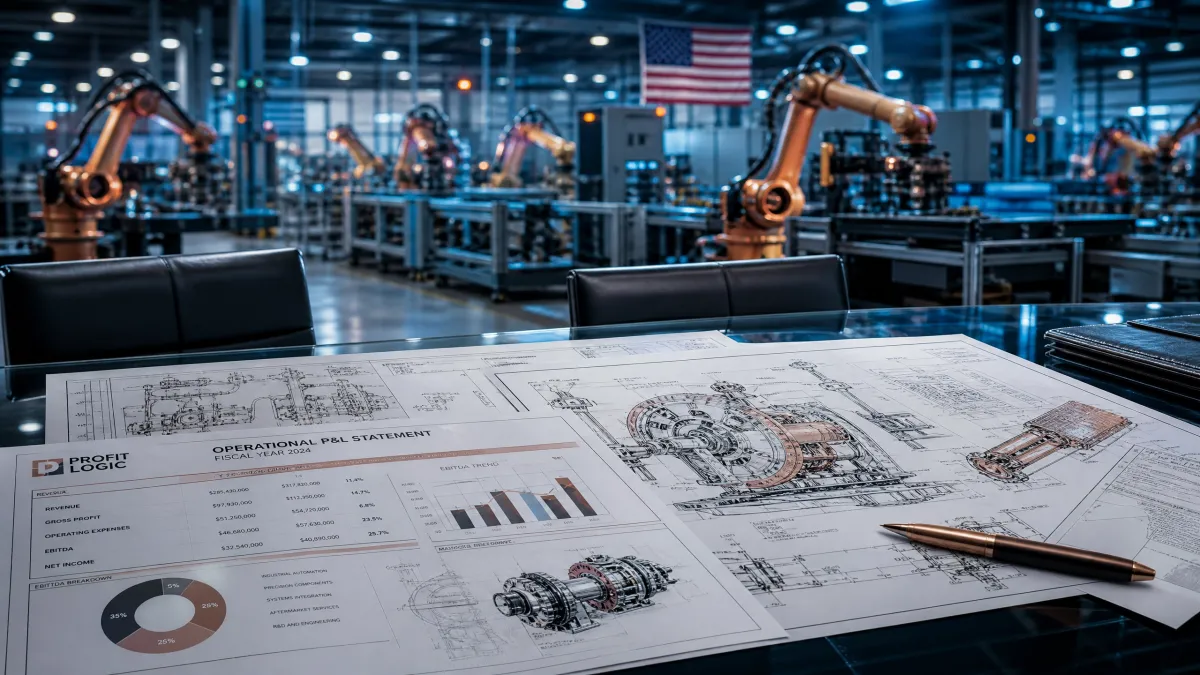
The Matching Capital Trap: Unlocking the American Subsidies Matrix for Industrial Scale
Every mid-market manufacturing executive has a file on their desk labeled with a Big Hairy Audacious Goal (BHAG). Whether that goal is doubling throughput by 2028, establishing a fully automated Tier-1 facility on domestic soil, or decoupling from volatile overseas logistics, the primary constraint is rarely engineering or ambition.
It is capital.
In the high-interest, high-audit industrial landscape of 2026, relying solely on commercial debt or dilutive private equity to fund massive capital expenditures is a compromise on your corporate sovereignty. Recognizing this, forward-looking leadership teams are actively scanning the shifting American regulatory horizon for non-dilutive capital.
The good news? The United States is currently deploying the most aggressive industrial subsidy engine in its modern history. The bad news? Most mid-market manufacturers are walking straight into a structural bottleneck: The Matching Capital Trap.
The federal, state, and municipal programs designed to fund your expansion are not hand-outs. They are cost-sharing partnerships. If you cannot produce the required in-kind funding from your existing balance sheet, millions of dollars in non-dilutive funding remain permanently out of reach.
To achieve your BHAG, you must understand the architecture of the American subsidy matrix—and learn how to extract the matching capital required to unlock it from within your own operations.
I. The Multi-Tier American Subsidy Matrix
Government funding operates across three distinct layers: Federal macro-incentives, State regional infrastructure development, and Municipal/County localized operational tax credits.
+-------------------------------------------------------------------+
| THE AMERICAN SUBSIDY MATRIX |
+-------------------------------------------------------------------+
| LAYER 1: FEDERAL MACRO-INCENTIVES |
| (CHIPS Act / Section 48D, OBBBA Title III, REAP / IRA Sec 48) |
+-------------------------------------------------------------------+ | v
+-------------------------------------------------------------------+
| LAYER 2: STATE REGIONAL DEVELOPMENT |
| (Focusing on the Industrial & Great Lakes Manufacturing Belts) |
+-------------------------------------------------------------------+ | v
+-------------------------------------------------------------------+
| LAYER 3: LOCAL/MUNICIPAL INCENTIVES |
| (PILOT Programs, County Industrial Revenue Bonds) |
+-------------------------------------------------------------------+
1. The Federal Layer: Macro-Incentives and Industrial Sovereignty
Federal programs are built to secure supply chain resilience, advance national security, and accelerate the energy transition. They offer massive capital injections but carry the highest administrative and auditing burdens.
Advanced Manufacturing Investment Credit (AMIC) - Section 48D: Following legislative enhancements via the One Big Beautiful Bill Act (OBBBA), the Advanced Manufacturing Investment Credit has been elevated to a 35% tax credit for qualifying facilities placed in service before the looming December 31, 2026 construction deadline.
Target Industries: Semiconductors, microelectronics, advanced sensor arrays, and related sub-tier equipment manufacturing.
Basic Requirements: Commencement of physical construction on a domestic fabrication or advanced component facility before the year-end deadline; strict adherence to "Prohibited Foreign Entity" (PFE) supply chain rules. Learn more via the official IRS Advanced Manufacturing Investment Credit Guidance.
The Benefit: A direct, massive offset of capital expenditure that dramatically shortens the payback period on automated production lines.
The Defense Production Act (DPA) Title III Incentives: Administered by the Department of Defense, this program issues direct grants, purchase commitments, and loan guarantees to ensure domestic capacity for critical industrial inputs.
Target Industries: Aerospace components, critical mineral processing (cobalt, lithium, nickel), advanced computing hardware, and dual-use industrial electronics.
Basic Requirements: Proven capacity to scale production of an item deemed critical to national security; a strict forensic audit of facility cybersecurity (CMMC compliance). Program details can be tracked through the DoD Office of Defense Production Act Allocations.
The Benefit: Direct, non-repayable cash injections to expand or re-tool existing facilities, coupled with long-term federal purchase agreements that guarantee baseline revenue.
Qualifying Advanced Energy Project Credit - Section 48C: Expanded under the Inflation Reduction Act with a $10 billion allocation program, this tax credit drives investments into building clean energy supply chains and reducing greenhouse gas emissions at domestic industrial sites.
Target Industries: Clean energy manufacturing (wind, solar, grid modernization components), heavy industrial decarbonization, and critical materials refining.
Basic Requirements: Competitive application process requiring proof of commercial viability, job creation, and net emission reductions. Review the application portals through the DOE Office of Manufacturing and Energy Supply Chains.
The Benefit: Up to a 30% tax credit on the capital investment of re-equipping, expanding, or establishing an eligible industrial facility.
Additional Federal Programs to Consider:
USDA Rural Energy for America Program (REAP): Offers guaranteed loan funding and grant money to rural agricultural producers and small manufacturing plants for renewable energy systems or energy efficiency improvements. Review the criteria via the USDA REAP Portal.
NIST Manufacturing Extension Partnership (MEP) Competitive Awards: While individual businesses do not apply directly for the primary federal block grant, mid-market plants can leverage localized technical assistance, automation grants, and digital modernization subsidies deployed through their state's MEP center. Explore your state's network via the NIST MEP National Network.
2. The State Layer: Regional Competitiveness and Workforce Infrastructure
State programs are single-mindedly focused on jobs, regional GDP growth, and securing domestic manufacturing capacity. They are highly flexible and faster to deploy than federal grants. For manufacturers operating within the traditional American industrial and Great Lakes corridors, the regional incentives are dense and highly targeted.
Here is how eight key manufacturing states deploy their primary capital and modernization programs:
Ohio | JobsOhio Growth Grants & Economic Development Loans: Ohio’s private economic development corporation offers flexible funding models designed to accelerate capital investment.
Target Industries: Industrial machinery, automotive components, materials science, and food processing.
The Benefit: Low-interest, partially forgivable loans and direct grants to offset site preparation, machinery acquisition, and specialized workforce training costs. Review open programs at JobsOhio.
Michigan | Michigan Business Development Program (MBDP): A performance-based incentive program targeting companies that make highly competitive capital investments within the state.
Target Industries: Electric vehicle (EV) supply chains, advanced automation, robotics, and defense manufacturing.
The Benefit: Non-dilutive cash grants used to offset the friction of capital expansion and automated asset commissioning. Access guidelines at the Michigan Economic Development Corporation (MEDC).
Indiana | Manufacturing Readiness Grants (MRG): Administered by the Indiana Economic Development Corporation (IEDC) in partnership with Conexus Indiana, this targeted grant actively subsidizes the transition to Industry 4.0 operations.
Target Industries: Precision machining, automated assembly, industrial IoT implementation, and advanced plastics.
The Benefit: Matching grants up to $200,000 specifically designated for the purchase of advanced capital equipment, including robotics, cobots, and machine-learning diagnostic arrays. Review open funding rounds via the IEDC Portal.
Wisconsin | Wisconsin Economic Development Corporation (WEDC) Business Development Tax Credit: A flexible, performance-based tax credit program that supports regional business expansions.
Target Industries: Advanced manufacturing, fabricated metal, heavy equipment production, and biotechnology.
The Benefit: Direct corporate income tax credits calculated as a percentage of your capital investment in new equipment, real property, and workforce training. Review eligibility rules through the WEDC Portal.
Illinois | Economic Development for a Growing Economy (EDGE) Tax Credit: Illinois’ primary mechanism for encouraging capital investment and job creation over out-of-state site alternatives.
Target Industries: Automated logistics machinery, aerospace assembly, precision plastics, and chemical processing.
The Benefit: Substantial credits against state corporate income tax liability based on the payroll of newly created positions, freeing up critical operational cash flow. Explore the program through the Illinois Department of Commerce & Economic Opportunity (DCEO).
Pennsylvania | Pennsylvania First Program (PA First) & Manufacturing Tax Credit (MTC): A comprehensive toolset combining discretionary grants and specialized tax credits for capital improvements.
Target Industries: Advanced materials, specialized defense sub-contracting, automation equipment, and primary metals.
The Benefit: Direct fund reimbursements for machinery procurement, job training, and infrastructure construction, paired with credits to offset state corporate net income tax. Apply via the Pennsylvania Department of Community & Economic Development (DCED).
New York | Excelsior Jobs Program (Excelsior Manufacturing Track): A robust package of fully refundable tax credits specifically structured for clean-tech and advanced industrial hubs.
Target Industries: Clean-energy components, pharmaceutical hardware, high-tech ceramics, and semiconductor sub-tier suppliers.
The Benefit: Includes a 5% Investment Tax Credit for new manufacturing capital expenditures and a refundable Jobs Tax Credit to offset operational payroll friction. Review the application process at Empire State Development (ESD).
Iowa | High Quality Jobs (HQJ) Program: Designed to provide financial assistance to businesses making major capital investments that elevate regional economic diversification.
Target Industries: Industrial machinery, bio-renewables, value-added food processing, and specialized transport equipment.
The Benefit: Local property tax exemptions on new value added by the project, sales tax refunds on construction materials, and a refundable state investment tax credit. Access application pathways via the Iowa Economic Development Authority (IEDA).
A Macro-View of State Incentives:
Beyond these eight specific industrial anchors, the landscape across other states remains vast and highly competitive. Texas continues to deploy its massive Texas Enterprise Fund (TEF) as an aggressive "deal-closing" tool, while Florida offers its performance-based Quick Response Training (QRT) grants to offset automated asset commissioning costs. States like Tennessee and South Carolina utilize robust infrastructure funds and job development credits to systematically target mid-market expansions.
Forensic Oversight Note: There are quite literally hundreds of state-level discretionary funds, technical modernization grants, and targeted environmental remediation offsets available across all 50 states. It is highly recommended that manufacturers review the specific economic development portals of their own respective states, as localized funding criteria are constantly being modified to out-compete regional neighbors.
3. The Municipal & County Layer: Hyper-Localized Operational Relief
Local government programs are designed to expand the local property and sales tax base over a 10-to-20-year horizon. They deal primarily in operational expense reduction.
Payment in Lieu of Taxes (PILOT) Programs: Local economic development authorities freeze or discount property taxes on real estate and major industrial equipment.
Target Industries: Heavy manufacturing, logistics infrastructure, and large-scale assembly plants.
The Benefit: Immediate, predictable operational cost relief. Rather than paying full property taxes on a newly modernized, $40 million facility, the manufacturer pays a fraction of the cost via a structured schedule for 10 to 15 years.
County Industrial Revenue Bonds (IRBs): Local governments issue tax-exempt bonds to finance land acquisition and construction on behalf of a private manufacturer.
Target Industries: Mid-market precision machining, chemicals, and fabricated metal operations.
The Benefit: Access to capital at interest rates significantly below commercial market averages, paired with exemptions from sales taxes on construction materials and manufacturing equipment purchases.
II. The In-Kind Reality and the Matching Capital Trap
A granular review of the American subsidy matrix reveals a hard operational truth: The government does not finance the full journey to your BHAG. Every program listed above requires a severe financial commitment from the manufacturer. Federal programs like DPA Title III and the Strategic Response streams routinely demand a 50% cost-share. State programs require a baseline of private capital expenditure before performance-based cash is unlocked. Municipal PILOT programs require you to buy and install the equipment before the tax relief can materialize.
+-----------------------------------------------------------------+
| THE MATCHING CAPITAL BOTTLENECK |
+-----------------------------------------------------------------+
| $10M Federal / State Grant Opportunity |
+-----------------------------------------------------------------+
| | |
| Requires a 50% Private Match |
| v |
| +-----------------------------------------------+ |
| | $5M Cash Injection Needed From Company | |
| +-----------------------------------------------+ |
| | |
| How do most companies fund this? |
| v |
| +-----------------------------------------------+ |
| | [❌ BAD OPTION 1] High-Interest Bank Debt | |
| | [❌ BAD OPTION 2] Dilutive Equity/Cap Table | |
| | [⚡ PROFIT LOGIC] Extract 4% From Legacy OpEx| |
| +-----------------------------------------------+ |
+-----------------------------------------------------------------+
If your facility is pursuing a $10 million expansion to hit your production BHAG, a federal grant might promise $5 million. But to claim it, you must prove you have the other $5 million ready to deploy.
Most mid-market manufacturers look at this requirement and see only two paths:
Take on high-interest commercial debt, which stresses operational cash flow and degrades debt-service coverage ratios (DSCR).
Dilute ownership by bringing in private equity, compromising long-term strategic control.
This is the Matching Capital Trap. It stalls brilliant expansions because the upfront cost of unlocking "free money" is too high.
III. The Profit Logic Capabilities: Uncovering Your Free Capital
There is a third path—an offensive cash strategy that doesn't touch your equity and doesn't involve a commercial lender.
At Profit Logic, we view the manufacturer’s P&L through a forensic lens. We know that the average mid-market manufacturing plant operates with an invisible, structural 4% leakage in legacy Operational Expenses. This leakage is not found in your raw material costs or your direct labor hours; it is deeply embedded in complex, non-strategic spend categories: vendor contract misalignments, invisible tariff classifications, structural maintenance anomalies, and utility rate-structure distortions.
This 4% is your Modernization Dividend.
When we partner with a leadership team, our objective is to run a forensic sweep across these legacy spending structures to isolate, reclaim, and redirect that 4% leakage. On a $50 million manufacturing P&L, that 4% represents $2 million in annualized, recurring cash flow that is currently being handed to vendors and administrative structures.
In the context of the American subsidy matrix, that $2 million is not just "cost savings." It is your non-dilutive matching capital.
By deploying Profit Logic’s capabilities, you can systematically extract the 4% leakage from your existing operations and use it as the explicit, in-kind funding required to unlock federal and state matching grants.
Instead of debt or dilution, you fund your American expansion using the capital you were already spending—you are simply changing the destination of the dollar. You reclaim it from inefficiency and apply it directly to your BHAG.
If you are serious about scaling your U.S. operations, stop looking outward for capital loans, and stop assuming government grants are out of reach. The capital required to fund your modernization is already inside your facility. Let's go find it.
