
The Modernization Dividend: Reclaiming Structural Capital for the Global AI Race
The recent shift toward a Single National AI Policy (USA) marks a critical inflection point in industrial scaling. By moving away from a fragmented, state-by-state regulatory patchwork, the administration has cleared a path for unified federal standards designed to fuel global competitiveness [2.2]. However, for the manufacturing executive, this external standardization is only half of the equation. The reality of 2026 is that a standardized federal policy cannot solve an un-standardized internal data environment. Many firms remain hamstrung by a "patchwork" of their own—siloed legacy systems and un-governed operational data that act as a friction point for any high-level AI integration.
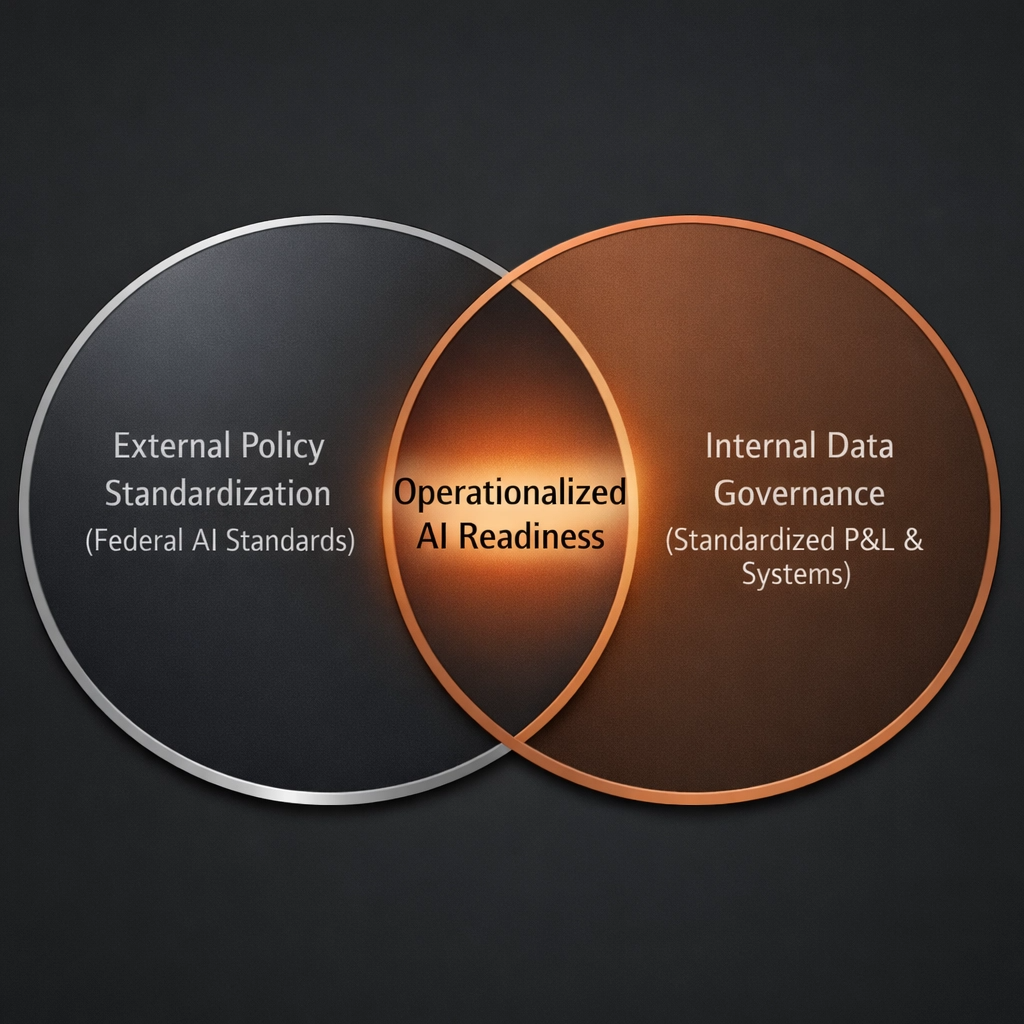
To participate in what the National Association of Manufacturers (NAM) calls the "global race for AI," organizations must first achieve Structural Capital Reclamation. This principle moves beyond traditional cost-cutting; it is the clinical identification and capture of the Maintenance Tax—the ~4% of revenue silently eroded by vendor inertia and administrative decay. Without this reclamation, the "Agentic AI" models currently being deployed by firms like Palantir and Bain remain theoretical [7.1]. Operationalizing intelligence requires a foundation free of structural leakage.
This need for internal liquidity is further highlighted by the diverging paths of major industrial players facing trade volatility. The recent "Audit Shock" at Harley-Davidson (USA), which resulted in $67M in lost profits due to retaliatory tariffs, illustrates the high cost of a reactive P&L [10.1]. Conversely, the decision by EnerSys (USA/Mexico) to shutter its Mexico facility and reshore production to Missouri demonstrates the power of strategic agility. Reshoring and "Ally-Shoring" are not merely manufacturing decisions; they are capital allocation decisions. The ability to pivot a supply chain in response to a Section 301 probe (USA) or a CUSMA Sunset Review (Canada/USA/Mexico) requires liquid capital that is not tied up in legacy operational waste.
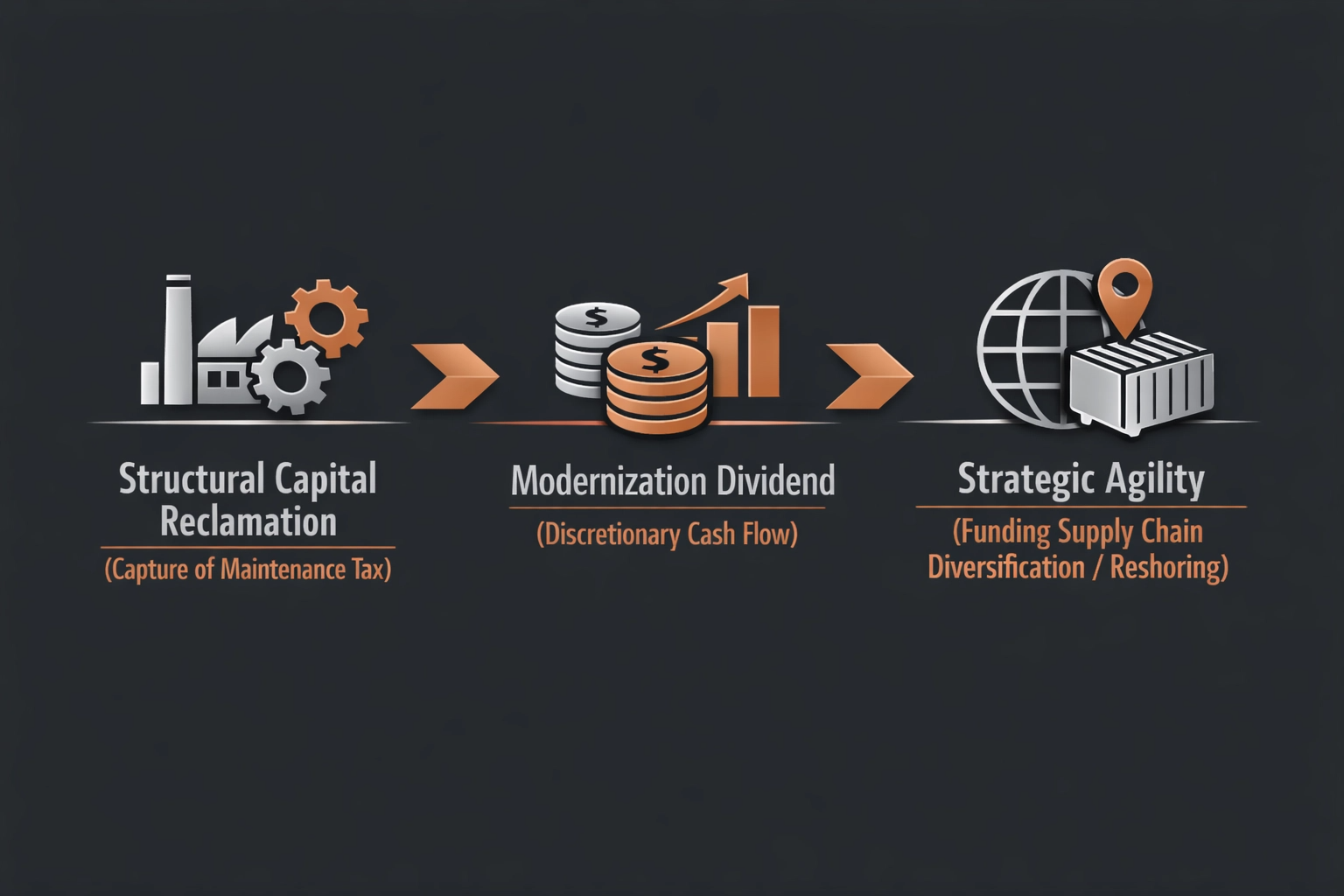
The global landscape is rewarding those with the liquidity to move fast. The landmark Critical Minerals Deal between the EU and Australia is a prime example of "China-Bypass" strategy, securing direct pipelines for lithium and aluminum while eliminating 99% of tariffs [5.1]. For manufacturers in both the US and Canada, the lesson is universal: Supply Chain Sovereignty is the new standard, but it carries an admission price. Whether a firm is navigating the 40% productivity gap in Ontario or expanding a shop floor in the Midwest, the "Modernization Deferral" caused by trapped capital is the primary antagonist.
Ultimately, the distinction between the "Unstoppable" manufacturer and the one managed through austerity comes down to governance. By reclaiming structural capital, leaders create a Modernization Dividend—a self-funding stream of reinvestment that allows for the acquisition of Physical AI and the relocation of supply chains without the burden of 2026 debt loads. In an era defined by rapid technological and geopolitical shifts, the most valuable asset an executive can hold is discretionary capital.
Strategic Execution: Profit Logic facilitates this transition by acting as an Autonomous Forensic Engine. Through our Success-Based Stewardship model, we secure the ~4% EBITDA lift required to fund these 2026 mandates. We remain in the trenches for 36 months to ensure that structural reclamation is not a one-time event, but a permanent pillar of the organization's financial governance.
[2.2] White House/NAM Policy Release: March 24, 2026. "Unified Framework for Industrial AI Standardization."
[10.1] Q1 Trade Impact Report: March 25, 2026. Harley-Davidson tariff losses ($67M) vs. EnerSys reshoring strategy.
[5.1] EU-Australia FTA Signing: March 26, 2026. "Securing Critical Mineral Corridors for the Post-China Era."
[7.1] Bain/Palantir Strategic Partnership: March 26, 2026. "Scaling Agentic AI in the Industrial Sector."
