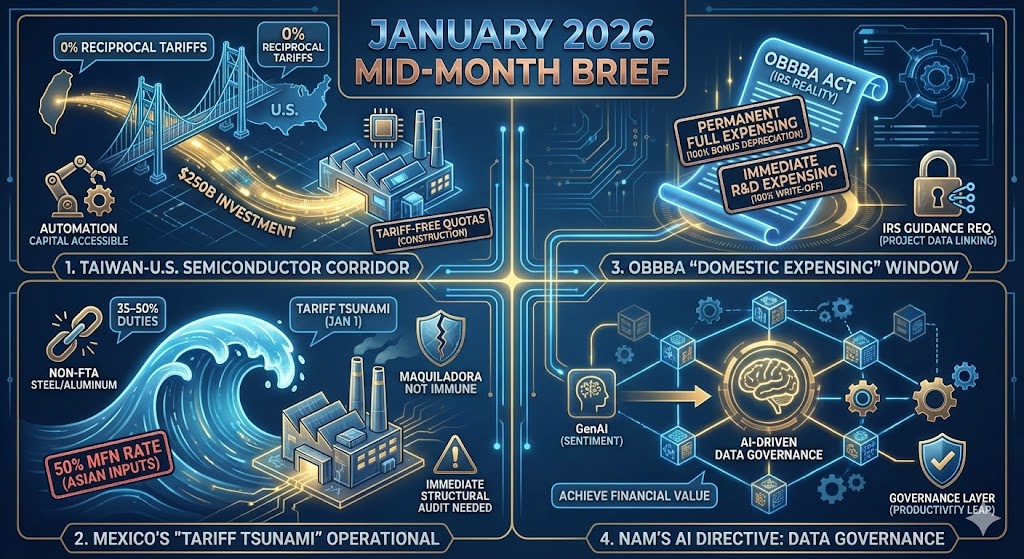
The $250 Billion Green Light: Why "No Budget" is No Longer an Excuse for Stalled Automation
On January 15, 2026, the industrial landscape changed. The landmark U.S.-Taiwan trade agreement hasn't just secured US chip supply; it has effectively subsidized the North American "Modernization Dividend." With $250 billion in direct investment and zero-percent tariff quotas for aircraft and critical components, the barrier to "Physical AI" and robotics isn't the cost—it's your Data Governance.
The New Fiscal Reality Between the Taiwan Corridor and the One Big Beautiful Bill Act (OBBBA), the federal government has handed manufacturers a dual-motor engine for growth:
Zero-Tariff Quotas: Taiwanese firms and their U.S. partners now have "tariff-free windows" to import the hardware needed for construction and expansion (Source 1.2).
Section 174A Immediate Expensing: The 5-year amortization "tax on innovation" is dead. You can now write off 100% of domestic R&D and software development in Year 1 (Source 7.1).
The "IMMEX" Warning Shot While the Taiwan deal provides the "carrot," Mexico’s DOF Decree provides the "stick." New analysis of the USMCA "Lesser of the Two" rule confirms that Maquiladoras are no longer a safe haven for non-FTA inputs. If your Mexico-based operations are still showing 2025 margins, you are likely carrying a hidden 35–50% tariff liability that will hit your balance sheet by Q2 (Source 6.1).
The Verdict: You don’t need a bigger budget; you need a Structural Audit. The capital for your 2026 "Agentic AI" roadmap is already on the table—either in the form of recovered OpEx leakage or immediate OBBBA tax-shields.
[1] Source 6.1: USMCA Article 2.5 ("Lesser of the Two" Rule) as applied to the Jan 1, 2026 DOF Decree, requiring duty payments on non-FTA inputs in IMMEX operations.
[2] Source 7.2: IRS Revenue Procedure 2026-04, detailing the "Data-to-Dollar" linkage requirements for Section 174A domestic R&D expensing.
