The Technology Ownership Divisor: Self-Funding Your Valuation Premium in the Q2 M&A Market
Step into any industrial private equity boardroom in late May 2026, and you will find that the traditional valuation playbook for mid-market manufacturing has fundamentally fractured.
For decades, evaluating a precision machining plant, a tier-1 automotive supplier, or an advanced materials fabrication facility followed a predictable script: calculate trailing twelve months (TTM) EBITDA, apply a regional industry multiple, and adjust slightly for customer concentration.
Not anymore.
As we cross the midpoint of Q2 2026, corporate buyers and private equity groups are applying a ruthless new architectural filter to their acquisitions. They are no longer buying raw capacity or simple volume. They are buying technological sovereignty.
Faced with a structural demographic cliff and a permanently tight high-skill labor pool, buyers are looking at mid-market plants through a binary lens. If your facility relies on a legacy, human-intensive operational model to hit its throughput targets, your valuation is being discounted. Conversely, if your facility owns its automated process technology, holds proprietary data loops, and operates with a highly digitized asset base, your valuation is commanding an unprecedented premium.
This structural split is driven by The Technology Ownership Divisor. It is a hidden valuation penalty that turns what looks like a thriving, profitable business into an underperforming asset in the eyes of the market—and it is a trap that mid-market leadership teams must solve before they test the liquidity waters.
I. The Anatomy of the Divisor: Job Shop vs. Tech Platform
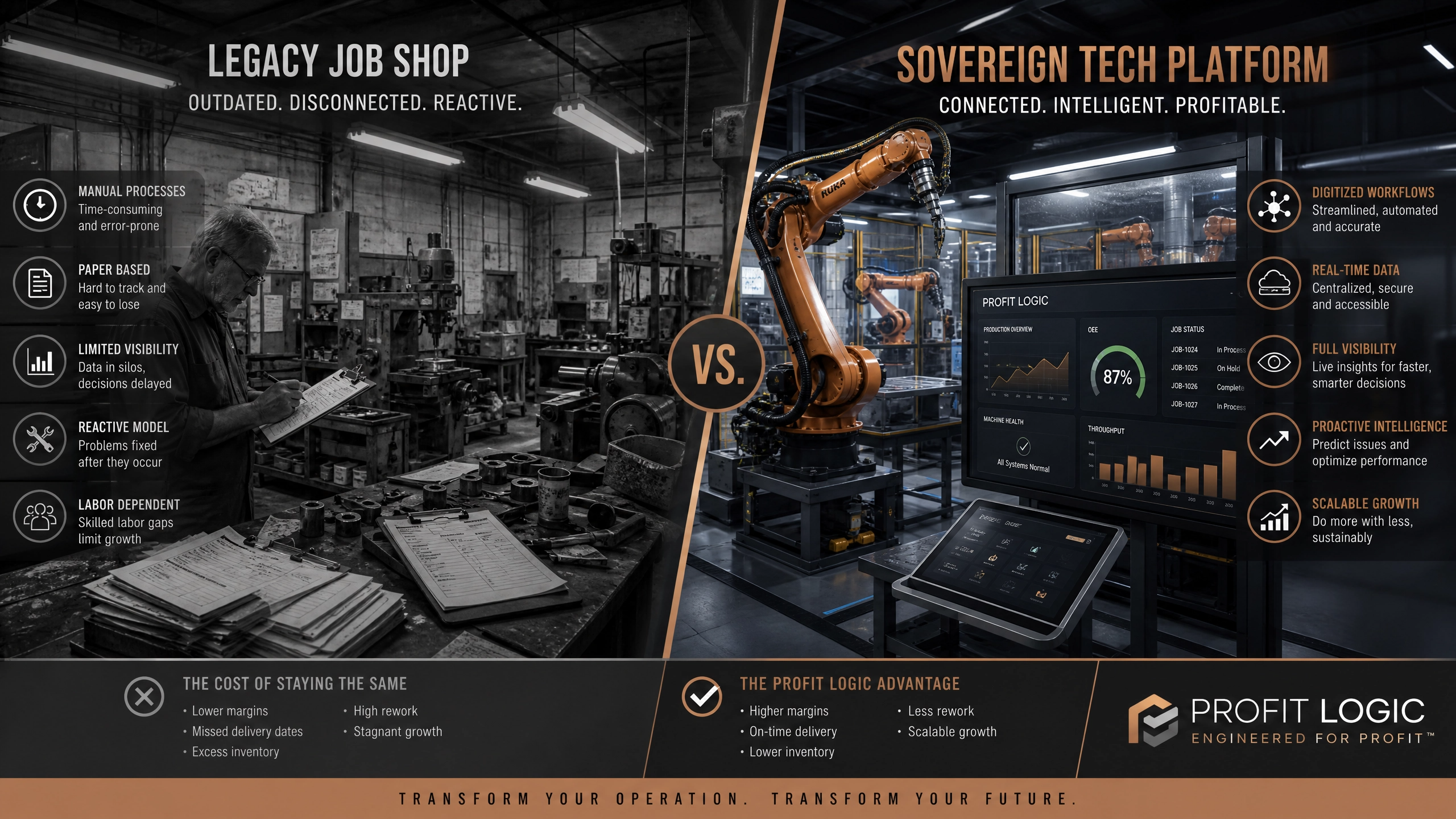
The valuation gap between a traditional "job shop" and a modernized "technology platform" has widened into a structural chasm. Consider two identical $40 million manufacturing operations in the industrial corridor, both generating $5 million in baseline EBITDA:
+-----------------------------------------------------------------+
| THE MULTIPLE DIVORCE: A TALE OF TWO P&Ls |
+-----------------------------------------------------------------+
| FEATURED OPERATING MODEL: |
+-----------------------------------------------------------------+
| COMPANY A: THE LEGACY JOB SHOP |
| • Highly dependent on manual setup and human operators. |
| • Data stored in fragmented, unlinked silo spreadsheets. |
| • Valuation Multiple: 4.5x - 5.5x EBITDA |
| • TOTAL ENTERPRISE VALUE: ~$25,000,000 |
+-----------------------------------------------------------------+
| VS |
+-----------------------------------------------------------------+
| COMPANY B: THE TECHNOLOGICAL PLATFORM |
| • Industry 4.0 automated arrays with predictive analytics. |
| • Proprietary CNC/robotic configurations owned internally. |
| • Valuation Multiple: 8.5x - 10x EBITDA |
| • TOTAL ENTERPRISE VALUE: ~$46,000,000 |
+-----------------------------------------------------------------+
Why does the market penalize Company A while rewarding Company B with a premium that nearly doubles its enterprise value? Because Company A is deeply exposed to operational friction. Every unfilled shift, every wage escalation, and every tribal-knowledge retirement threatens its forward-looking cash flow.
Company B, by owning its technology platform, has successfully decoupled headcount from revenue growth. Its automated cells don't experience fatigue, require structural wage corrections, or exit the business to join a competitor.
Private equity groups view Company B as a highly scalable engine that can absorb bolt-on acquisitions effortlessly. Company A is viewed as an optimization project carrying high execution risk. In the 2026 M&A market, owning your proprietary technological process is no longer an operational milestone—it is a mandatory governance strategy.
II. The Capital Dilemma: The Cost of Modernization in 2026
Most mid-market CEOs and CFOs recognize this valuation cliff. They understand their Big Hairy Audacious Goal (BHAG) requires an immediate, aggressive capital injection into robotics, automated material handling, and predictive manufacturing execution systems (MES).
But this is where they hit the capital wall.
Implementing a comprehensive Industry 4.0 modernization program across a multi-line facility requires significant upfront capital. In the current 2026 financial climate, traditional financing routes come with severe strategic compromises:
Commercial Bank Debt: Securing industrial equipment loans at current commercial rates places a major burden on monthly cash flow, tightening debt-service coverage ratios (DSCR) and restricting forward agility.
Outside Equity: Bringing in growth-stage private equity or venture debt to fund the technology stack dilutes ownership, transferring a significant share of that hard-earned valuation premium to outside investors before the business ever reaches a liquidity event.
Faced with the choice between expensive debt or dilutive equity, many leadership teams delay their modernization plans. They choose to wait out the market, hoping interest rates drop or capital costs ease.
But waiting is a passive strategy that plays directly into the hands of the Technology Ownership Divisor. Every quarter you delay automation is a quarter your valuation multiple slips relative to your modernized peers.
III. The Profit Logic Bridge: Activating Your Internal Venture Capital Fund
There is an alternative strategy that protects your equity and keeps your balance sheet clean. You do not need to look outward for capital to fund your technology transformation. The capital is already inside your building—it is simply being spent on structural inefficiencies.
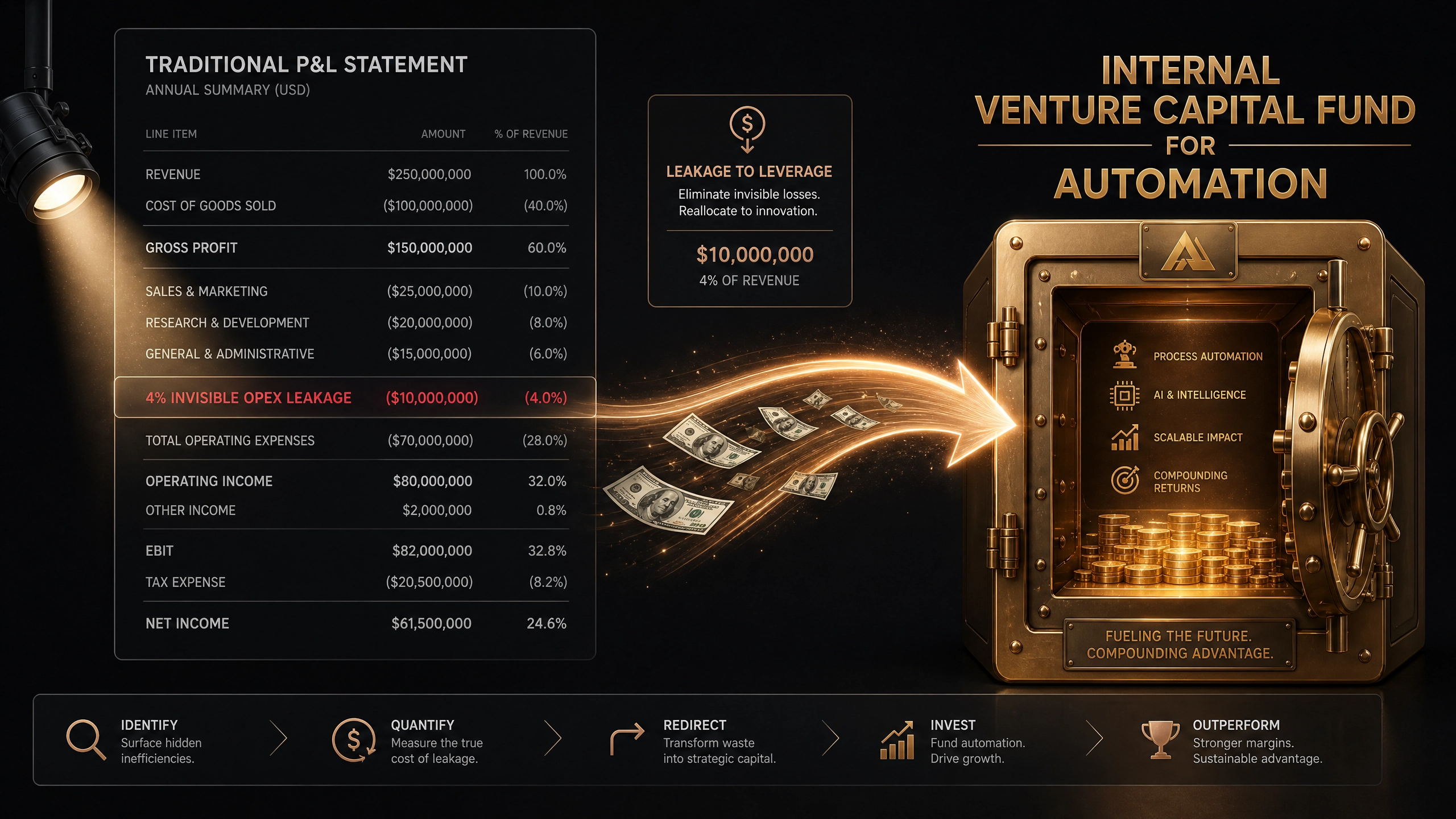
At Profit Logic, our core capability is executing a forensic diagnostic sweep across a manufacturer’s legacy operational expenses (OpEx). We consistently find that the average mid-market plant operates with an invisible, structural 4% leakage deeply embedded in non-strategic spend categories. This waste isn't sitting out in the open on the factory floor; it is locked inside complex vendor misalignments, utility rate anomalies, un-optimized maintenance contracts, and hidden administrative cost creeping.
This 4% is your Modernization Dividend.
On a $50 million manufacturing P&L, that 4% represents $2 million in annualized, recurring cash flow that is currently leaking out of your business.
+-----------------------------------------------------------------+
| THE INTERNAL CAPITAL RECOVERY ENGINE |
+-----------------------------------------------------------------+
| Legacy P&L Spend Architecture |
| [====================================================] $50M |
+-----------------------------------------------------------------+
| |
| Profit Logic Forensic Sweep Isolates 4% Waste |
| v |
| [❌ Legacy Leakage: $2,000,000 ] |
| |
| Reclaimed Cash Redirected to the Technology Platform |
| v |
| [⚡ Internal Venture Fund: Self-Funded Automation Arrays] |
| |
+-----------------------------------------------------------------+
Instead of treating cost recovery as a simple belt-tightening exercise, forward-looking CEOs use it as an Internal Venture Capital Fund.
By deploying Profit Logic’s capabilities to stop the leakage, you instantly free up $2 million in non-dilutive, organic capital. That cash flow can be funneled directly into purchasing, owning, and embedding the advanced automated arrays required to turn your operation into a high-value technology platform.
You don't take on expensive commercial debt. You don't hand over equity to outside investors. You simply reclaim your own capital from operational waste and use it to permanently eliminate the Technology Ownership Divisor.
By upgrading your technology stack using your own reclaimed operational dollars, you accomplish two critical strategic objectives simultaneously: you expand your current EBITDA margins, and you lift your entire business into a premium valuation multiple. That is how you build true corporate sovereignty, achieve your BHAG, and exit the market on your own terms.
